Katherine Coble shared a story about her husband's experience with Samuel L. Jackson, in which Jackson stole her husband's cab.
Back when I used to watch MTV, I remember watching a special on celebrities and how they lived. It spoke about how when celebrities showed up at clubs, they simply told people sitting at a table to get up. I believe it was my wife who said, "Isn't that what white people used to do to black people."
Same with the cab story. I could just imagine back in the 1960s, or even today, some white person shoving a black person out of the cab because they had to make their tee time.
Now, I know this really is not an issue of race, but I believe there is an underlying commonality with how some white people treated black people (some still do) and how celebrities treat the peasant folk. As Katherine said in response to my comment about this commonality on her blog,
"Interesting point. I think it has something to do with the perception of priviledge translating to worth.
Some white people used to be treated better solely because of their whiteness. They thought that meant they were actually worth it, and others worth less.
Replace "white" with "celebrity" and you have the same thing."
So, what is my point? I really don't know. It just bothers me when I hear of celebrities treating other people like trash, because, in many ways, it is the same type of behavior seen in race relations.
But it is easy to bash on celebrities and point out the flaws in other people. So, I have to examine myself and see if there is any of that in me. Do I think of certain groups of others as "less" than me? Do I ever think I am hot stuff? Do I ever look at my occupation and compare it to the occupation of others? Do I think I am superior just because I am really, really, ridiculously good looking?
Thursday, August 24, 2006


Wednesday, August 23, 2006
I've been tagged by Josh
1. One book that changed your life: The Book of Matthew
2. A book you read more than once: The Screwtape Letters by C.S. Lewis
3. A book you would want on a desert island: Probably the entire Chronicles of Narnia (I haven't read it yet, but I am about to, and I figure I would want a long book) by C.S. Lewis
4. A book that made you cry: Hmmm, I don't know if I've ever cried while reading. I suppose if there was a book called the Death of Cute Kittens, that would make me cry.
5. A book that made you laugh: SeinLanguage by Jerry Seinfeld
6. A book you wish had been written: Chance, Pinnacle of Masculinity and the Coolest Guy who ever Lived
7. A book you wish had never been written: I would agree with Josh and say the Koran.
8. Book I am currently reading: Keeping Your Wife Your Best Friend by Clarence Schuler.
9. Book I am planning on reading: Becoming One: Emotionally, Spiritually, and Sexually by Joe Beam. At least I think that is the one my friend is reading.
10. Person to tag: I think Michael has done it before, so I'll tag Dan and Lee.
Live, at an undisclosed location
Well, I traveled for the first time since the whole terrorism apprehension issue in the UK. A few observations.
1) Security lines are definitely slower, but I am not sure why. Inspection didn't seem more thorough than usual. Oh wait, I know why. There was only 1 line open.
2) Standing as close as you can to the person in front of you, invading their personal space, while standing in the security line will not make the line go any faster.
3) In my short time of traveling, I have found that what works best when exiting the airplane is that the front row goes first, followed by the second, and so on... Come on people, it's not rocket science.
Tuesday, August 22, 2006
What arrives in my junk mail folder
Why do I feel like I am getting emails from a schizophrenic? This text was below an ad for some "rising stocks."
His eyes were open; he was glaring up atme. What it was you knew to be truth by the threesigns they gave you. The little woman came running out of the fern brake.
Also, in a fight I use my left hand better than I do my right.
The little man smiled at me, and trilled.
Nor whatelse there might be of living things.
They looked at Jim with curiosity and interest and with no trace ofunfriendliness.
Her hands werefull of thick, heavily veined leaves. Instantly thepost-hypnotic command to the subconscious operated. When I summon you, then see that you obey! Others, curiosity not yet quenched, tooktheir places. A milky sap streamed through her fingers and dropped uponthe black, corroded spot. Several times he had to repeat this before she caught it.
Although at that, we know so damned little Iwouldnt rule it out. I watched suspicion grow, and thereturn of bitter hate.
Jim said, laughingly:Its the food of the Yunwi Tsundsi youre eating. I looked at Evalie, and at the wine and amber beauty of her. I went on to something else that had been puzzlingme. They made me feel asGulliver must have felt among the Liliputians. The pygmies watched us wriggle into them with frankamazement.
Its rim was thick and fleshy, like a round white mouth. I studied the plain for the hundredth time. I couldsee no path, but the golden pygmies knew their way.
None was tallerthan the one I had saved from the white flowers. There was agony in them, and there wasbitter hatred. I looked back, up the face of the black cliff.
There was no fear nor hatred in her eyes.
Theycarried long, slender spears and small round targes.
Around her hips wasthe white loin-cloth of the Little People.
The Wolf-womans eyes were like sapphirestars, her free hand was raised in summons. She would have passed in sleep, in peace,without pain .
They were earth-folk,worshippers of life; and as such at times outrageously Rabelaisian. The little woman came running out of the fern brake.
Jim with the tentacle of that Dark Powercreeping, creeping toward him . The littlepeople had only watched, and laughed, and urged the women to bring memore.
Since it is plain he still thinks me that . Although at that, we know so damned little Iwouldnt rule it out. Jim was staring down upon the golden pygmy like a man in a dream.
He leaped backinto the brake, motioning us to follow. His gaze wandered to my hair, and I saw amazement banishthe hatred.
Looking at it, another way...
Here's a situation. What if a business was coming to town that would provide jobs for many middle class workers? Say about a thousand or two thousand? In addition, it would make products much cheaper for the middle class. Let's say the cost of living for the middle class, including groceries, yardwork supplies, and even a movie for the family to watch, decreases?
But wait, there's a catch. If this store comes in, many of the rich shopowners will lose their jobs. People will support the new store, providing jobs for the middle class, because it helps their middle class cost of living. But, 20 rich people will lose their jobs, and 1000-2000 jobs will be provided for the middle class.
Would you support the existence of this new business?
But let's change it around a little bit. Let's knock the classes down one notch. Instead of the store providing jobs for the middle class, it provides for the lower class. And many of the customers are members of the lower class, not the middle. And the people losing their jobs are not rich shopowners, but middle class ones.
Does this change anything, and why?
Monday, August 21, 2006
The Marketplace of Churches
There was a special on Dateline a couple of weeks ago on Carlton Pearson, a preacher in Tulsa, Oklahoma who teaches the idea of universal salvation. Josh from Gabbatha also mentions the piece and talks about hell in general at his blog.
Pearson was a very successful preacher, but when he had his supposed "revelation" and started teaching on it, the congregation left, and he received letters from his mentors and peers in the ministry urging him to change course.
Of course, Dateline painted it as a picture of a man being persecuted for his beliefs. But Ted Haggard, pastor of the enormous New Life Church in Colorado Springs said, to paraphrase "if people don't like what you are saying, they leave. It's the marketplace."
Now, saying the church is like a marketplace may cheapen what church is to some. In fact, I don't really like using the term, but it made a catchy title. After all, church should not be portrayed as a business where people simply come to on Sundays and get what they need. The church should not be selling a "product" that we can just snatch up. But I don't think Haggard really meant that. I think what he meant is that if a preacher espouses a doctrine that people do not like, they have every right to leave. Pearson was not being persecuted, his congregation has every right to seek spiritual guidance in other places. This is for better (people change churches to avoid what they feel is false doctrine), or for worse (people feel too challenged by biblical truth so they go somewhere to "feel good.").
While it is unfortunate that the body of Christ can be so divided, with so many different denominations, I wonder if it can be a good thing as well. The problem with a more uniform religious body is that it is more susceptible to false doctrine, whether intentional or not. With multiple churches and denominations, if one preacher or conference leader gets something wrong, it does not trickle down to the whole body.
Ideally, we would all have a perfect understanding of the Bible, and none of us would get it wrong. However, some of us do. Because man is imperfect and makes mistakes when interpreting God's word, I find it a good thing that someone has a choice when choosing churches. A "marketplace" is better than a monopoly.
What Real Power does Wal-Mart have?
Wal-Mart has been getting many jabs from politicians. I was watching the news the other day and some Democratic legislator was criticizing Wal-Mart because it "had too much power in the hands of a few people."
Now, I have posted on Wal-Mart before. I have defended Wal-Mart. I do admit though, I didn't give some criticisms that much credit. The concern that Wal-Mart closes down mom-and-pop stores is a legitimate one. However, Wal-Mart is successful because it gives customers what they want. A free market will not guarantee jobs for everyone, but I do believe it provides customers with products in the most efficient manner possible. Small businesses may not be able to compete according to price, but they will have to be create and compete in other ways.
But back to the claim about Wal-Marts "power." My claim is that Wal-Mart has no real power over us. No one has to go to Wal-Mart. Does my electric and gas company have some power over me? Sure. I don't have that much flexibility in choosing my methods of power delivery. If I was a progressive criticizing companies, I would go after them. But, I never have to go to Wal-Mart. Never, ever, ever, ever, ever. Wal-Mart has no power over me whatsoever. None. At no point do I have to go to Wal-Mart. I can go to Target to get similar things. I have the choice of several grocery stores to buy what I need. I can go to Home Depot or Lowe's for stuff around the house. I can go to Radio Shack or Best Buy for electronics.
To be honest, I rarely go to Wal-Mart. I typically avoid it because it is so friggin' busy. I am willing to pay a little bit extra to avoid the nightmare that is Wal-Mart. Obviously, because it is so busy, other people make different choices, saving the amount of money they do is important enough to them. I was in their position when I was a poor college student, where saving money was more important than avoiding a busy store. So do many on the lower rungs of the economic ladder.
There is also the issue of Wal-Marts employement policies. This is really part of a bigger issue concerning the free market and workers wages. Again, concerning Wal-Mart's "power", workers are free to work at other places.
But say that Wal-Mart did pay their workers more. Then, either Wal-Mart would have to raise prices, or Wal-Mart would make less profit. If Wal-Mart makes less profit, then shareholders are less likely to invest in the store. If Wal-Mart raised prices, then it would defeat what is good about Wal-Mart. As I mentioned earlier, Wal-Mart helps the poor simply by offering products at lower prices. So where is the tradeoff. We can't have low prices and have high wages. One affects the other. So who decides if higher wages or lower prices are better? I say, let the free market decide.
I realize that many of these issues have to do with one's overall belief in the free market in general. Personally, I think Wal-Mart is a testament to capitalism's greatest strengths, providing products as cheaply as possible. But there is the part of Wal-Mart that involves low wages for workers. I personally do not think that is a bad thing, because it provides a workplace for those with little to no job skills. If one feels that people are entitled to a certain wage and health care, then they will not care for Wal-Mart. Personally, I believe the pay at Wal-Mart provides a good reflection of what the employees have to offer.
Again, the success of Wal-Mart is due to the customers. People say Wal-Mart should be held accountable to the people. I believe they are, to the people who shop there. When war is declared on Wal-Mart, war is declared on the shoppers.
Friday, August 18, 2006
I don't know how much I will be posting within the next week or so. Right now my mental and emotional energies are directed elsewhere. My sister-in-law (my wife's sister) and her boyfriend were involved in a car accident a couple of weeks ago. The boyfriend is not too bad off, but the sister-in-law is currently in rehabilitation. It could have been worse, and I thank God it wasn't. Anyway, that is what is going on. That is where my heart is right now.
Update: My sister-in-law is done with rehab and is home with her parents right now.
Update: My sister-in-law is done with rehab and is home with her parents right now.
Thursday, August 17, 2006
OT Economics
I keep saying that I will post more on economics, but I have not yet, due to lack of time. I've had some long posts recently, but I wanted to examine the system of welfare in the Old Testament and try to apply it to today. However, that involves rereading certain parts of the Old Testament that I just have not had a chance to do.
From what I know right now, it sounds like the Jubilee Law was a way of returning land back to original owners and forgiving debts, and that the Israelites were told to loan to each other at 0 interest. Also, some offerings were taken for the poor.
If we were to model that welfare system today (whether we should or the extent that we should is another issue, I am saying If), the immediate applications I see involve loans and bankruptcy laws. This makes sense. I think out of the welfare that exists, the best kind are loans, simply because someone will spend their money more efficiently if they know they have to pay it back. Also, a loan is less of a handout, as opposed to simply giving money. Loans have a bigger tendency to help people help themselves, and the most obvious application is that of student loans.
I suppose bankruptcy laws that are not too harsh would be another application. However, I don't think the creditor should have to suffer the consequences due to circumstances surrounding the debtor. So I suppose any costs associated with bankruptcy would be transferred to the taxpayer.
I have not read the part about the offering for the poor yet.
Again, I'm not advocating anything, I am just saying that if we did try model the Mosaic form of welfare, those may be some ways. Since we see such a radical change with how one relates to God from the OT to the NT, some may argue that the Mosaic model may not apply. Michael in a previous post said that we can look at their priorities and base our government off that. I believe we would both agree we should model those priorities on a personal level, but if we should do so on a governmental level is the issue with which I am dealing.
I do want to add that I do believe that giving to others is an essential part of the Christian relationship, and one that is not emphasized enough. The message last Sunday at church was the story of when the sheep are separated from the goats. The sheep are the ones who feed the hungry and clothe the naked, and by doing so to "the least of these" they do so to Jesus. The goats...well, not so much. I know the message convicted me, because I can always do more.
Wednesday, August 16, 2006
ID vs. Evolution, and the Real Issue
Should schools teach Intelligent Design or Evolution?
First some remarks on ID. Is ID science? I can see why some critics would say it is "religion disguised as science" or "creationism lite". However, I believe one should consider the claims that it makes without automatically dismissing it. ID does seem different from other sciences in that it makes extrapolations based on patterns in nature. If ID lacks the solid science, fine. I don't see issues with considering the ideas of what has not been proven. Who says God has to be the intelligent designer? Maybe some guy created a society in his test tube, which is us? The idea may seem a little ridiculous, but who is to say that some advanced society beyond our comprehension did not cook us up? I believe God created us, I am just demonstrating that "ID" does not equal "God did it."
As far as evolution, from a science perspective, if the science and data are there to support the idea, great. I'm not a biologist, I'm more of a physical science type. But science should not become dogma. If there are holes in evolutionary theory, present them. If there are questions to be asked, ask them. The reason I say this is because even criticizing aspects of the theory of evolution must go through a legislature in many states. This should not be. Science should be about asking questions. For the Law of the Conservation of Energy and The Second Law of Thermodynamics, the textbook will say quite plainly, "this has never been proven. It is based on empirical data."
But really, when it comes to schools, these issues are of secondary importance. The issues of primary importance are, "how do we decide what is taught to our children." Who says that a state or district court has to decide for everyone? In my view, parents should be able to choose if they want to send their children to a school that teaches evolution, or ID. We would not be fighting endless cultural wars over how to educate our kids. Parents would be able to decide for themselves.
Such a claim brings criticisms. First of all, for those who believe ID is not science, they would criticize the notion that parents would prevent their children from learning "real science." But to those I would say, how do you know that the government knows what real science is? The government may be viewed by some as an objective force that upholds reason that would not be influenced by religious matters, but I would disagree. Even if this was the case, what do your own children have to lose? Worry about raising your own kids, not others.
Perhaps the issue is trust for the parents vs. trust for the government. In some cases, I would put my trust in the government. For example, we allow parents some autonomy in raising their own children and choosing how to discipline them, but we don't allow abuse. I support seat belt laws and car safety laws for children.. But I believe the parents should have authority on how their children are educated.
How do we know they would make the right choice? We don't. But how do we know the government will make the right choice? I prefer decentralizing such decisions. Also, parents can learn from each other. Which method of teaching math is best? Does abstinence-only education work, or safe-sex education? Studies will be done, and parents can do what is shown to work best. Parents can send their children to a school that is an extension of their own values, rather than parents' values battling it out in a one-size-fits-all school system.
On a totally unrelated note, does anyone besides me find it amusing that the word "blog" fails on the spell-check.
Monday, August 14, 2006
A question for those who tend left on economics
At the end of my previous post, I stated
What do you think? The free market is a place of mutual transactions. I imagine the biggest argument against the free market is in the case where someone does not have money for their daily sustenance. What if they cannot afford a piece of bread? Some may say that for that very reason, the free market should be regulated, so that people's lives are not at the mercy of the free market.
However, how do you determine when to regulate the market, and when to just have additional benefits concerning welfare? For the above quote, do you think it is preferable for government to provide the money for the bread, or to direct the market so that bread is not so expensive? If an adequate welfare system is in place, why is there a need to regulate the market (concerning prices and wages)?
I'm not trying to imply an answer within my questions, I was just curious.
Finally, as a compromise, I believe we can have a free market and still have a basic welfare system. If someone cannot afford a loaf of bread, I think it is better to have a welfare system that provides the money for the loaf of bread, rather than regulate the price of bread.
What do you think? The free market is a place of mutual transactions. I imagine the biggest argument against the free market is in the case where someone does not have money for their daily sustenance. What if they cannot afford a piece of bread? Some may say that for that very reason, the free market should be regulated, so that people's lives are not at the mercy of the free market.
However, how do you determine when to regulate the market, and when to just have additional benefits concerning welfare? For the above quote, do you think it is preferable for government to provide the money for the bread, or to direct the market so that bread is not so expensive? If an adequate welfare system is in place, why is there a need to regulate the market (concerning prices and wages)?
I'm not trying to imply an answer within my questions, I was just curious.
Capitalism, Hooray!!! Materialism, Boo!!!
On a previous post, Michael stated this about the tyranny of the market.
Wow, very concise and thoughtful statement on negative aspects of the market. His comment led me to make the post. Now, by doing this, I am not saying "You're wrong and here's why!" It is just that comments inspire posts, and by addressing them, my purpose is not to point out what's wrong with their comments, but it is thoughts inspired by their comments.
Michael is right on many things here. Our society is individualistic (my words, not necessarily his). The idea of mutual exchanges and benefits are great when it comes to the markets. It is a bad way to approach life. The whole goal of Christianity is not to get tit for tat, but to give of ourselves unselfishly. We can start to see everything in selfish terms; what value is it to us? Whether it be our wife, children, friends...
Furthermore, capitalism can destroy relationships. How many men (and some women) work so hard to provide for their families, and in the process, neglect their families? How many people neglect their relationship with God to pursue the almighty dollar?
The comment about destroying mountains or forests for its economical value is a valid point as well. Some people believe that capitalism, while exploiting nature for resources, still favors the preservation of some nature. Whether or not that is true is the topic for another day. If this is not the case, then I think government has a valid role in preserving land, such as mountains or certain forests.
Michael did rightly call me on not reading the The Wealth of Nations, even though I don't think he was addressing me directly. I have not read it, but I will put it on my list. I typically don't use him as a source, since I don't like the way he phrases things ("each pursuing our own rational self-interests"), for reasons beyond the scope here.
Advertising does produce an atmosphere of commercialism. Heck, it taints one of the most important holiday of the year (I would say Easter is on par with Christmas in terms of significance). Yes, we would probably be inclined to buy less stuff if people weren't showing us shiny new things on TV. While some early capitalists may have not foreseen advertising, I think they would have seen it as an extension of salesmanship.
In a previous post, I expressed my concerns about capitalism, for some of the reasons mentioned above, and what Michael mentioned. After all, the idea behind capitalism is that if everyone pursues their own self-interests, the world will run smoothly.
I like to look at it a different way. To me, capitalism is essentially economic liberty. In a sense, a free market allows us to be greedy or to be charitable. Michael refers to the market as tyrannical, but I see it as people being tyrannical under a freer system. Under our economic system, we have seen much greed. At the same time though, our economic system produces a large amount of wealth. This wealth allows those who happen to be generous and wealthy to do a large amount of good. During the tsunami around the 2003/2004 crossover, the individual giving from the U.S. outweighed the U.S. government giving.
It is a similar situation with any other freedoms. I could go on countless hours talking about the things permissible under freedom of speech. There are things produced that directly blaspheme God, and blaspheme his creation. The beauty that is a Woman is being prostituted everyday, for one. I could go into countless other things.
Also, I believe that other economic systems have problems as well. I realize that critics of "unfettered market forces" do not believe in an outright rejection of capitalism, but I am just showing how different systems each have their own problems.
Capitalism can lead to reliance on self, other than God. Socialism can lead to reliance on government, rather than God. Abuse of capitalism leads to disintegration of the family structure. So does the European way. Dr. Morse of the Acton Institute notes
This piece is not intended to convince anyone of anything, it is just primarily for myself. I'm sure anyone could blow holes on things that I say. I do not believe in materialism or commercialism, and I do not thing that idea of a "mutual exchange" is something that should be carried into other areas of life. Essentially, I believe in freedom, and I believe that capitalism is economic freedom. At the foundation of the free market are free exchanges. Is this post the best defense of such a system? I doubt it. For right now, I believe in freedom. I may come to find out that I am placing much to emphasis on freedom, that there should be more of a balance between security and freedom. Who said freedom is the highest goal? Right now, I do not know any better.
Now, that is not to say that capitalism should be completely laissez-faire. But I do believe in the idea of a mutual agreement between two parties to exchange goods or services. Should this be regulated somewhat to avoid potential abuses? Yes, to some extent. Just like freedom of speech is regulated to some extent. After all, you cannot yell "Fire!" in a crowded building.
Finally, as a compromise, I believe we can have a free market and still have a basic welfare system. If someone cannot afford a loaf of bread, I think it is better to have a welfare system that provides the money for the loaf of bread, rather than regulate the price of bread.
Here is some of what I have in mind about the tyranny of the market: 1)How often do successful businesspeople have to uproot families and move in order to get ahead in a company? This is probably less thanks to telecommuting, but it is still huge. 2) The role of advertising, something not forseen by Adam Smith. (I insist that all supposed free market folk actually READ the Wealth of Nations. Why is it that, I, a democratic socialist, seem to know the foundational text of modern capitalism better than most capitalists?) Advertising creates "needs" for things that no one needs. In fact, people who use propaganda for political or war purposes, study advertising. 3)Unfettered market forces can never appreciate anything for itself, just for its market value--thus any virgin forest is a potential tree farm. Any mountain valued only for whatever minerals can be mined from its depths--even at the cost of the mountain itself. Any work of art is only valued for its sales value. 4) Unfettered market forces are acidic to relationships. After teaching us all day every day that humans are no more than "rational self-interested consumers" (Friedman), we come even to view spouse and children this way. (E.g., the trophy wife) When they are no longer useful to our individual advancement, we leave for other market-driven relationships. Even supporters of capitalism often admit that it is the biggest macro cause of family disintegration. (Although about more than just laissez fair capitalism, Marshall Berman's _All That is Solid Melts Into Air_ speaks strongly to this.)
Then there is the way the market replaces wisdom with mere technical knowledge, so that if something CAN be built, it suddenly must be built, mass produced, and sold--no matter how unwise this would be. Conservatives rail against things like in vitro fertilzation (with some justification), but its rationale comes from the free market ideology's affect on science: Conception, pregnancy, and birth are now marketable items. Surrogate motherhood is the same thing.
I could keep multiplying examples. We have to have markets. They are efficient distributors of necessary goods and services. Command economies such as in the old USSR don't work and take great tyranny to even come close. But market forces by themselves are equally tyrannical. We must govern markets rather than let them govern us.
That may take individual wisdom, counter-consumerist education and values in churches, etc.--individual morality, as you say. But it will also collective curbs on the power of the markets.
The alliance of social conservatives, including most conservative Christians, with free market fundamentalists, is ironic--because NOTHING destroys the values that social conservatives love faster than unfettered market forces.
Wow, very concise and thoughtful statement on negative aspects of the market. His comment led me to make the post. Now, by doing this, I am not saying "You're wrong and here's why!" It is just that comments inspire posts, and by addressing them, my purpose is not to point out what's wrong with their comments, but it is thoughts inspired by their comments.
Michael is right on many things here. Our society is individualistic (my words, not necessarily his). The idea of mutual exchanges and benefits are great when it comes to the markets. It is a bad way to approach life. The whole goal of Christianity is not to get tit for tat, but to give of ourselves unselfishly. We can start to see everything in selfish terms; what value is it to us? Whether it be our wife, children, friends...
Furthermore, capitalism can destroy relationships. How many men (and some women) work so hard to provide for their families, and in the process, neglect their families? How many people neglect their relationship with God to pursue the almighty dollar?
The comment about destroying mountains or forests for its economical value is a valid point as well. Some people believe that capitalism, while exploiting nature for resources, still favors the preservation of some nature. Whether or not that is true is the topic for another day. If this is not the case, then I think government has a valid role in preserving land, such as mountains or certain forests.
Michael did rightly call me on not reading the The Wealth of Nations, even though I don't think he was addressing me directly. I have not read it, but I will put it on my list. I typically don't use him as a source, since I don't like the way he phrases things ("each pursuing our own rational self-interests"), for reasons beyond the scope here.
Advertising does produce an atmosphere of commercialism. Heck, it taints one of the most important holiday of the year (I would say Easter is on par with Christmas in terms of significance). Yes, we would probably be inclined to buy less stuff if people weren't showing us shiny new things on TV. While some early capitalists may have not foreseen advertising, I think they would have seen it as an extension of salesmanship.
In a previous post, I expressed my concerns about capitalism, for some of the reasons mentioned above, and what Michael mentioned. After all, the idea behind capitalism is that if everyone pursues their own self-interests, the world will run smoothly.
I like to look at it a different way. To me, capitalism is essentially economic liberty. In a sense, a free market allows us to be greedy or to be charitable. Michael refers to the market as tyrannical, but I see it as people being tyrannical under a freer system. Under our economic system, we have seen much greed. At the same time though, our economic system produces a large amount of wealth. This wealth allows those who happen to be generous and wealthy to do a large amount of good. During the tsunami around the 2003/2004 crossover, the individual giving from the U.S. outweighed the U.S. government giving.
It is a similar situation with any other freedoms. I could go on countless hours talking about the things permissible under freedom of speech. There are things produced that directly blaspheme God, and blaspheme his creation. The beauty that is a Woman is being prostituted everyday, for one. I could go into countless other things.
Also, I believe that other economic systems have problems as well. I realize that critics of "unfettered market forces" do not believe in an outright rejection of capitalism, but I am just showing how different systems each have their own problems.
Capitalism can lead to reliance on self, other than God. Socialism can lead to reliance on government, rather than God. Abuse of capitalism leads to disintegration of the family structure. So does the European way. Dr. Morse of the Acton Institute notes
In addition to the high tax rates necessary to fund the social benefits, the labor regulations impose heavy costs on the young. Most European countries regulate wages and hours, requiring relatively high wages and mandating relatively low working hours. The European social model also requires employers to provide generous benefits such as health care, paid vacations, paid parental leave and the like.
These regulations and mandates have a negative impact on young workers by increasing the employers’ cost of hiring workers. The productivity of a skilled, experienced worker can justify this generous compensation package. But a young person, just starting out, may not produce enough to pay for the minimum required wage, much less the entire compensation package including health care, and paid time off. The result is that the young and the unskilled are less employable.
The high unemployment rate contributes to the delaying of marriage and child-bearing.
[...]
The system excludes those who are not skilled enough to be economically productive. But everyone begins their lives being not very economically productive. In practice, this means that the young are kept out of the labor market precisely at the time they are most biologically suited to begin forming families. It also means that those who are intrinsically poor, due to disability or low intelligence, are also excluded from participation in the labor market.
The welfare state has also contributed to the marginalization of marriage. Living with parents is not conducive to starting a family.
[...]
But this is not the only impact of the social assistance state on fertility and marriage. The life-time assistance of the state displaces the economic function of the family. The elderly don’t need adult children to support them in their old age. Women don’t need a husband to support them if they do have a child. Husbands become a nuisance, because the government will provide financial benefits without the inevitable difficulties of dealing with a flawed human being as a partner. In this environment, children become consumption goods, an optional life-style appendage to acquire only if one happens to enjoys children.
These economic subsidies to child-bearing have failed because they are attempting to replace the father. But economic security offered by taxpayers cannot replace the deeper support that a lifelong marriage can provide a woman and her children.
[...]
The social model has failed even in the cultural and social arena. For marriage is now considered optional for childbearing. Couples have a child first, see whether their relationship works, and then, perhaps, get married after the birth of their second child. High levels of social assistance make this casual attitude toward marriage possible.
[...]
Needless to say, a genuinely Christian social model would not have allowed itself to become so muddled about the meaning of something so basic as marriage. The combination of secularism, which discourages people from seeking meanings deeper than the material, and socialism, which attempts to satisfy the merely material needs, has led to this wide-spread social confusion.
This piece is not intended to convince anyone of anything, it is just primarily for myself. I'm sure anyone could blow holes on things that I say. I do not believe in materialism or commercialism, and I do not thing that idea of a "mutual exchange" is something that should be carried into other areas of life. Essentially, I believe in freedom, and I believe that capitalism is economic freedom. At the foundation of the free market are free exchanges. Is this post the best defense of such a system? I doubt it. For right now, I believe in freedom. I may come to find out that I am placing much to emphasis on freedom, that there should be more of a balance between security and freedom. Who said freedom is the highest goal? Right now, I do not know any better.
Now, that is not to say that capitalism should be completely laissez-faire. But I do believe in the idea of a mutual agreement between two parties to exchange goods or services. Should this be regulated somewhat to avoid potential abuses? Yes, to some extent. Just like freedom of speech is regulated to some extent. After all, you cannot yell "Fire!" in a crowded building.
Finally, as a compromise, I believe we can have a free market and still have a basic welfare system. If someone cannot afford a loaf of bread, I think it is better to have a welfare system that provides the money for the loaf of bread, rather than regulate the price of bread.
Thursday, August 10, 2006
What Lamont's victory says about Campaign Finance Reform
I am not much in favor of Campaign Finance Reform.
1) It blatantly violates freedom of speech. Television and radio are limited in what they can say during an election year. While I am in no way a fan of Michael Moore, the idea that his movie Farenheit 911 would violate campaign finance laws is very troubling. I suppose the motivation behind CFR is that it limits how money directs politics. I understand this concern, but free speech is free speech, even if that speech comes in the form of money. If we do not have freedom of speech, it really doesn't matter who gets elected. Not to be so dramatic and cliche, but the freedoms we have are typically worth more than who represents us.
2) It prevents change in the political arena. Edward Crane from the Cato blog posts the following based on the Lamont victory over Lieberman.
There is not a line in McCain-Feingold that isn’t designed to protect incumbents. The so-called Bipartisan Campaign Reform Act makes it a crime to even mention the name of a candidate for federal office in a radio or television ad within 60 days of a general election. No criticizing incumbents! But the worst part of these laws came with the 1974 Amendments to the Federal Election Campaign Act, which instituted a $1000 contribution limit to candidates running for federal office (now slightly more than $2000, but less in real terms than the ’74 limits). Incumbents have earmarks to pass around and large mailing lists. Challengers do not. Advantage, incumbents.Everyone complains about the two-party system. In my view, and others, CFR contributes to this.
Ned Lamont’s remarkable victory over three-term incumbent Sen. Joe Lieberman yesterday exposes the true nature of contribution limits. They aren’t about the “appearance of corruption.” They’re about preventing a challenger from having a snowball’s chance in hell of winning. The one “loophole” the Supremes created with their incoherent 1976 decision in Buckley v. Valeo was that candidates have rights the rest of us don’t have. Apparently, they can’t be corrupted by their own money, so there are no limits on what they can spend on their own campaigns.
More than 60 percent of Ned’s campaign expenditures came from Ned. Without Ned, Ned loses. In fact, no political observer thought any candidate dependent on a $2000 contribution limit had any kind of chance of ousting Lieberman. Ned was a very poor candidate. Inarticulate with zero charisma. But by spending his own money he enfranchised the Democrats of Connecticut who otherwise, given the contribution limits, were disenfranchised. The Democrats in Connecticut hate the war in Iraq, Lieberman has rather energetically endorsed it. Yet the federal election laws would have assured Lieberman reelection were it not for the “loophole.”
This anti-war election is directly analogous to my late friend Gene McCarthy’s race for the presidency in 1968. Gene used six-figure contributions from wealthy liberals like Stewart Mott who opposed the war in Vietnam to fund a campaign that ousted a sitting president from his own party. Gene often said that had the ’74 amendments to the FECA been in place in ’68, he would not have run. Campaign finance laws should not have the power to change American history. But they do. Give everyone the “loophole” of being able to spend as much of their own money to promote their political beliefs and we’ll throw a remarkable number of incumbents out of office. And with good candidates instead of bumbling millionaires.
What I was trying to say...
My last post was probably not well structured, I didn't write it all at once. This is basically what I am trying to say. There are two views of gov't I am pondering.
1) View 1. The Mosaic government can provide a good model of our government today concerning morality and economic matters.
2) View 2. The government is no longer led by God, but by deeply flawed humans. Because man is inherently evil and power corrupts, we should strive to limit government as much as possible. The goal is maximum freedom. Also, the New Testament seems to focus on the relationship between a person and God as an individual matter, not a government matter. Issues of morality and helping the poor should be priimarily issues of Christian obedience and love, not government issues.
No one has to belong to one view or the other, and it may be somewhat of a spectrum.
I would like to address the issue of the economy and welfare. There are some, like myself, who tend towards View 2, and believe in limited government, but do not believe in the abolition of welfare altogether. For such a situation, I believe one can still look to how economic matters were handled in the Mosaic Law. I will discuss those later.
Tuesday, August 08, 2006
What about the Mosaic government?
In my discussions with some commenters on this site, on this blog and theirs, we have often discussed the OT law in relation to economic matters, and how this applies today. I would like to discuss this a little bit further at a later time, probably the next post.
Here is my questions. Should we attempt to model the Mosaic government to some extent, and if so, to what extent? In the OT and the NT, we see what God expects of us, in terms of individual morality (typically, the "do not" commands) and of, what I call, collective morality, such as helping the poor. I realize that "collective" is a loaded term, but I do not mean it in any negative context, I just use the term to address interactions with others, mostly in an economic sense.
For the OT, the governmental law, and the law of God, were one and the same. Israel was under theocratic rule. In the NT, the situation was totally different. Government was hardly a godly form of rule. It was not an avenue for God to reach people; it was typically opposed to God, even when the religious authorities were involved! The morality of the NT was more on the individual level (for individual and collective morality), whereas in the OT, God addressed an entire nation as a collective. (Okay, now the terms may get a bit confusing.)
The NT does seem to be more about freedom, and a one-on-one relationship with God. Food matters are left up to the conscience of the Christian, to some extent. Matters of giving are also between the person and God. To be honest, I don't know if the tithe (literally, the 10%) is even a solid guideline. (I do recommend a predetermined, consistent amount to give, however). Christians of a libertarian persuasion often point to the "law of freedom" pointed out in the NT.
So where does that leave us? Should Christian morality be a matter of government? Should we attempt to model the features of the Mosaic law? In my view, if economic morality is enforced, so should individual morality. Why look at one side and not the other? If we look at one side, then we are looking at things through a liberal or conservative lens. We are taking biblical laws and passing them through a filter of our own political persuasions.
Part of me thinks that is the way to go, simply model a form of government based on the Mosaic one.
However, another part of me believes in limited government. I look at the situation of Israel, and that was a time when God led the people in a direct manner. They had a theocratic form of rule directly established by God. Today, we have a secular form of government with flawed humans establishing the laws. All humans are sinful; therefore, it is desirable to give them as little power as necessary. (Of course, we all disagree on how much power is necessary).
Furthermore, in the NT, we see Christian morality take place on a more individual level. Yes, God has his commands, but in the NT, we see the relationship with God on a person-to-God basis, rather than God interacting with the masses through a government. The New Testament does not focus so much on rules and regulations, but simply loving the Lord God with all your heart, and loving your neighbor as yourself. I've heard the saying that "Love is the Law."
What does that have to do with government. Love can really only flourish in an atmosphere of freedom. I could be wrong about that, I may have said it because it was a statement that sounds good. But let's examine it. Why doesn't God just make us live in a perfect world? In order to do that we would be zombies, people with no free will, at least, that's the explanation I have heard. If we have no free will, we cannot choose God. Christianity is centered so much around free will and choice. Satan had the free will to rebel against God. Adam and Eve had free will. We have free will when choosing to accept Christ. We can spit on God's face in the context of free will, but it is the only way we can truly love God.
To truly obey God, we must love Him. We treat our bodies as a temple out of love for God. We help the poor and needy because of our love for God.
But again, where does government get involved? I had my thoughts all composed, but this is getting to be a bit stream-of-consciousness. This is turning out not to be so much a statement for limited government, but simply not using government as a primary means of enforcing the Christian ideal. I have no problem with a basic welfare system, but I do have disagreements with using government as a means for Christian social action. Christian social action must be done out of love and free will, not coercion. This is not a statement on the "morality" of coercion, but to simply say that giving out of love and free will is of a higher "morality." This is not a statement against using the government as a means of social order, but when we rely on government as a means of moral order, we put too much faith in government.
More on this later...
Help me!!!
Now, all the time I hear about how evil Bush is. Much of this criticism has been how he cares only for the rich, and that he doesn't give a crap about the poor.
Now, I want to understand where those on the other side are coming from. I realize that many liberals hate Bush because of the Iraq war. I can understand this viewpoint, because I would never really like Clinton or Carter as president because of their views on abortion. My "abortion" is their "Iraq War." That's fine.
However, I also hear about how Bush, and really, Republicans, only care about the rich. I don't buy that. I would think Bush's domestic record would garner a little praise from liberals. In a Cato article, On Spending Bush Is No Reagan, (pdf file), Cato investigates how much spending has increased, by department.
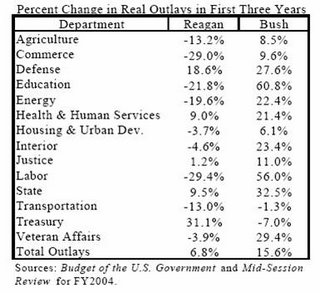
Oh my!!! Defense has grown 27.6%. That's quite a bit. But, Health and Human Services has grown 21.4%. That's hardly devoted to rich people. Oh, wait. Education has grown 56.0%. That means, take half of what was being spent on education, and add it back to the education money. In my view, that kind of assistance is the best. It is the ideal "hand up" assistance, not "hand out".
Now, this kind of assistance is not free from criticism. Liberals have charged that Bush is a "borrow and spend" kind of guy, not "tax and spend." However, I am not fighting the criticism about how Bush handles money, I am fighting the criticism that Bush only cares about the rich.
But wait, Bush has committed the unpardonable sin. He cut taxes for the rich. Whether or not the rich should have been paying 38% is never discussed. Despite my smart alec remarks, I can understand liberals having problems with this. However, tax receipts have grown with Bush's tax cuts, as they have with Reagan's, according to Wall Street Journal. Of course, the Wall Street Journal is hardly an unbiased source, and there may have been other factors involved in the economy. However, I ask this. Can someone perhaps provide the benefit of the doubt that maybe, just maybe, more is not always better when it comes to taxing the rich, from a philosophical and economical standpoint? That maybe there is a distinct possibility that cutting taxes sometimes spurs the economy? That maybe, 40% for the top bracket is just a little too high and too taxing on the economy? And that, even if you disagree, and think higher taxes are better, that maybe Bush is not cutting taxes because of some disregard for the poor, that he thinks cutting taxes may actually help the economy?
I titled this "Help me!!!" Help me believe that it is not a matter of liberals just hating Bush. Help me believe that Democrats actually have legitimate reasons for saying Bush loves the rich and hates the poor. I understand that liberals hate Bush because of the Iraq War, and his gay marriage amendment, and that he cut taxes for the rich, but I would think how he spends government money would at least give the hint of a smile on the face of a liberal. When someone says Bush has no concern for the poor, that leaves me utterly confused. Show me where I am going wrong.
Now, I want to understand where those on the other side are coming from. I realize that many liberals hate Bush because of the Iraq war. I can understand this viewpoint, because I would never really like Clinton or Carter as president because of their views on abortion. My "abortion" is their "Iraq War." That's fine.
However, I also hear about how Bush, and really, Republicans, only care about the rich. I don't buy that. I would think Bush's domestic record would garner a little praise from liberals. In a Cato article, On Spending Bush Is No Reagan, (pdf file), Cato investigates how much spending has increased, by department.

Oh my!!! Defense has grown 27.6%. That's quite a bit. But, Health and Human Services has grown 21.4%. That's hardly devoted to rich people. Oh, wait. Education has grown 56.0%. That means, take half of what was being spent on education, and add it back to the education money. In my view, that kind of assistance is the best. It is the ideal "hand up" assistance, not "hand out".
Now, this kind of assistance is not free from criticism. Liberals have charged that Bush is a "borrow and spend" kind of guy, not "tax and spend." However, I am not fighting the criticism about how Bush handles money, I am fighting the criticism that Bush only cares about the rich.
But wait, Bush has committed the unpardonable sin. He cut taxes for the rich. Whether or not the rich should have been paying 38% is never discussed. Despite my smart alec remarks, I can understand liberals having problems with this. However, tax receipts have grown with Bush's tax cuts, as they have with Reagan's, according to Wall Street Journal. Of course, the Wall Street Journal is hardly an unbiased source, and there may have been other factors involved in the economy. However, I ask this. Can someone perhaps provide the benefit of the doubt that maybe, just maybe, more is not always better when it comes to taxing the rich, from a philosophical and economical standpoint? That maybe there is a distinct possibility that cutting taxes sometimes spurs the economy? That maybe, 40% for the top bracket is just a little too high and too taxing on the economy? And that, even if you disagree, and think higher taxes are better, that maybe Bush is not cutting taxes because of some disregard for the poor, that he thinks cutting taxes may actually help the economy?
I titled this "Help me!!!" Help me believe that it is not a matter of liberals just hating Bush. Help me believe that Democrats actually have legitimate reasons for saying Bush loves the rich and hates the poor. I understand that liberals hate Bush because of the Iraq War, and his gay marriage amendment, and that he cut taxes for the rich, but I would think how he spends government money would at least give the hint of a smile on the face of a liberal. When someone says Bush has no concern for the poor, that leaves me utterly confused. Show me where I am going wrong.
Friday, August 04, 2006
More on taxes, later...
I would like to discuss more on taxes from a small-government, Christian perspective. Dan and Michael both present some good arguments for a liberal ideal of taxation, using Christian ethics and empirical arguments.
Right now though, I don't immediately have time, as I have an anniversary weekend coming up for my wife and I (Hooray!!!), and of course, working for the man. After all, those trees in the rainforest won't cut themselves down! Just kidding, Dan and Michael. I don't actually chop trees down. I capture baby seals for their fur. Okay, I don't do that either. Maybe I'll give a prize to whoever can guess what I do*.
* Any guarantees for prizes by Chance are null and void.
Thursday, August 03, 2006
On taxes
Before I go into progressive taxation, I want to state that I really do not know the ideal form of taxation. Each one has their own problems. The income tax and sales tax are intrusive, because it requires paperwork on every financial transaction made. The income tax has become very complicated, in which vast amounts of money and time are spent just trying to figure it out. The sales tax, I admit, is somewhat regressive, because it does hit the poor the hardest. Now, that statement may make me sound like a Democrat, but I think there is a difference between choosing a type of tax that does not provide extra burden on the lower classes, and engineering a tax system specifically to provide extra burden on the rich. The property tax has issues because it can still tax people who make little to no income. Some old lady that has vast amounts of land can still be taxed on it, even if she is living only on Social Security. Unless it is a couple decades in the future, then she won't have any Social Security.
So, the income tax is probably the fairest form of taxation, simply because those who make little, pay little, those who make much, pay much. I do believe the income tax should be simplified. Despite being somewhat conservative in many things, I do not believe in social engineering through taxes. I do not believe I should have gotten a tax credit (which I still accepted) for moving to a different state to get a job. It is not the government's role to spur individuals (or corporations) to make economic decisions. I should make a decision on a job based on what is best for me and my family, not because I get some tax credit. Corporations spend countless man power deciding on things such as profit-sharing plans, which are made extremely complicated by tax codes.
I also do not believe I should get a tax credit for getting a more efficient water heater. Shouldn't the fact that I spend less in energy bills be proper motivation? That's like me asking my next door neighbor "Hey Bill, I got a more efficient water heater, now give me some cash because of my good efforts in saving money." Of course, I know there are differing opinions on this, by those who believe government should take an active role in conserving resources, and their opinion is understandable.
The overall point is, Congress keeps saying they want to simplify the tax codes. Then, they pass some new legislation giving exemptions or credits to individuals or corporations for doing certain things. The income tax should be simple. Instead of passing a 25% tax on a certain group with exemptions, simply pass a 20% tax without exemptions, except for charity.
Now, concerning the tax rate. Sometimes, I think the high tax rates are a symptom of big government. At the same time, however, I believe that government does get extra money at times, and simply just finds ways to spend it.
There is a view that tax rates should be no more than 10%. After all, 10% is good enough for God, why not the government? Granted, God does expect and sometimes ask more than what a person gives in tithe to their church, but the idea common in modern day Christianity is that there is a 10% tithe to the church that is expected, and anything beyond that is between them and God. What if the same idea was mirrored with giving in general? Ten percent, at the most, expected in taxes, and anything else that a person wants to give, whether to their church or some other charity, is voluntary.
What about progressive tax rates? That is, tax rates that increase, based on how much income one makes. The common argument is that the rich can afford to pay more in taxes, the poor cannot. Of course, I would just say, "Find the rate that the poor can afford, then have everyone pay it. " I like that idea, but people's ideal governments are bigger than my own.
I had this discussion with Michael the Leveller concerning his post on Economic Justice. For a liberal perspective on taxes, give his blog a visit. His post kind of inspired mine, which is really probably the opposite of his. I guess you could call me Bizarro Michael.
I could probably go to the Cato website and find data showing that progressive taxes don't work, but I feel like that has less meaning if I have an idea, then look up a random site to support my thoughts. I typically like to read an article, and if it makes sense to me, post on that. Anyway, my empirical argument against progressive taxation is this. The rich are typically the most productive concerning the economy. Their investments and personal spending spur job creation. In addition, the rich have more room to give to charitable work, Bill Gates being the example. High tax rates diminish this. Part of the argument concerns the size of government in general. I, being limited government, do not believe that this money is productive in the first place.
From a philosophical standpoint, I do not have much ammunition, other than "it just does not feel right." Or actually, it seems too easy. Taxing the rich more because they can afford it just seems like a solution that is too simple. Schools need more money? The rich have some money to spare! Health care too expensive? Need preschool for the kids? Notice that I use examples that are really good things. I feel that the philosophy behind progressive taxation is that the many benefits so much, with so little cost to the few. To the economically liberal, I feel that it's like "the rich don't need that money anyway", or "it costs so little to them." And I apologize if I am putting words in the liberals' mouths. This is just the devil's advocate viewpoint I come up with when trying to view things from another perspective. Here's the thing though. For one, there are no easy, intuitive solutions. I believe freedom is a easy solution in the sense that it is a simple concept, but it is not always the immediately easy solution. It is not intuitive, but actually counter-intuitive on many occasions. Progressive taxation seems too easy.
Also, the laws of nature typically state that something that benefits a lotwill cost a lot. Nothing is for free. Energy is conserved. However you want to look at it. The thing with progressive taxation is that people believe they have a situation in which so much is gained for so little. The "so much" being the billions of dollars that mean so much to the poor. The "so little" meaning the thousands or millions of dollars of one individual, who has a lot of money anyway. The idea I have here is that something that seems to come so cheaply will end up biting people back. Yeah, Bill Gates has so much money, so he can afford to be taxed millions of dollars. Right? Like I said, nothing is for free. How does that bite people back? I believe in the examples that I gave. Less money given to effective charity, and less job creation.
Another situation with progressive taxation is that it can set up a system of envy. With flat taxation, everyone pours into the pot and get something out. With progressive taxation, it sets up an "us" vs. "them" situation. If something is needed, like a new government program, we do not chip in and all make the sacrifice. We ask others (the rich) to make the sacrifice. Democracy can become a tool for personal gain. Instead of working harder for college money or health insurance, one can simply legislate money from the rich. I am not saying all Democrats are looters, but it sets up a system in which looting becomes possible.
In summary, income tax is probably the way to go, concerning the forms of taxation. However, I believe this tax should be simplified. I am not necessarily advocating one tax bracket for all people, but I do not believe that we should set up a system in which there is such a large discrepancy between the tax brackets. Such a solution may seem easy, but I do not believe there are any easy answers.
Wednesday, August 02, 2006
Here we go again...
Well, Mel made a complete fool of himself as you all have probably heard by now. One of the sad things about this is that it affects the perspective of Passion of the Christ. Critics of the movie are now saying "Ah hah! I knew it! Passion of the Christ was anti-Semitic!
This is an old issue, but one that is being raised again, thanks to Mel's brush with the law.
A few points.
1) The fact that the bad guys in a movie belong to a certain ethnic group is, by no means, necessarily intended to target an ethnic group in a certain way. The fact is, the people who participated in the murder of Jesus were Jewish and the Roman. That's a matter of history, not just of the Bible. You cannot edit a movie and ignore historical fact. Is Schindler's List anti-Germanic because the bad guys did heinous things to the Jews? That was a separation of 50 years, not 2000. What about Roots? Is that anti-whitey? Should that movie have not been made because it could result in bad feelings towards white people?
2) The people who killed Jesus just happened to be Jews. The people who killed Jesus were simply greedy for power. It wasn't an issue of Judaism vs. this new way Christ was introducing. Otherwise, the Pharisees and Sadducees would have dismissed him as a wacko and let him be. However, they knew He was a threat to their position. The land of Israel just happened to be where God chose to send His Son.
3) Jesus died for our sins. The Jews and the Romans happened to be His instruments, but it was our sins that put Him there in the first place.
4) True Christianity in no way harbors hatred towards the Jews. There may be some supposed, even actual, Christians, who claimed that the Jews killed Christ and harbor resentment because of their collective rejection as Christianity as Messiah. However, this is not applying true Christianity. If someone hates the Jews because of the crucifixion, that is because they are ignoring the tenets of Christianity, not applying them. Growing up as a Christian, I don't believe I, for one, gathered hatred from the Jews through the Bible or my Christian teachers/leaders. It's just not a natural response to the whole story. Growing up, I never thought, "Oh, it was the Jews that killed Him." As I said earlier, they just happened to be the ones, instead of the Grecians, or Swiss.
Why is retelling the story of the crucifixion anti-Semitic? That, and the resurrection, are central pieces to Christianity, yet I believe an overwhelming number of Christians have a love for the Jews, or at worst, an indifference. The few wackos who uses the crucifixion for hatred of the Jews are hardly the norm.
The motivation behind limited government
I believe that politics and public policy has a certain duality to it. I like to call this a philosophical/empirical duality. That is, the validity of a philosophy of a certain political action will determine how effective that policy is. In other words, policies that are philosophically good, or sound, or whatever word you want to use, will also be very effective. Policies based on bad philosophies will end up being a disaster.
This could work two different ways. Look for programs, or lack thereof, that have worked in the past, and base other programs on them. At the same time, make sure that policies are ethical, that have moral means as well as ends. The morality of certain policies has been questionable, but they have been implemented anyway because they have been seen as a quick fix to a problem, but end up being disastrous later.
In an earlier post, I stated that libertarians and small gov't conservatives should focus not on the morality of redistributing money, but on whether doing so is even effective. One thing that I believe the Cato Institute does effectively is argue small government ideals from a practical perspective, arguing that more government programs do more harm than good.
When I first delved into limited government ideals, I was, at the same time, reading the book Atlas Shrugged. This book is in a way, a thesis for the philosophy of objectivism, which argues that each man should work for their own highest good. Man should not harm other man, but at the same time, they should feel no obligation to help their fellow man. Of course, being a Christian, part of this philosophy is appalling, but I did agree with some of the ramifications in the political sphere, in that it led to a freer economy and elimination of huge entitlement programs, and it still influences some of my beliefs in supply-side economics (I never heard a formal definition of that term, but I think it means that the supplier of the goods sets the terms of production). It also, at the time, made me abhor the philosophy of redistribution. Although I didn't reject the welfare state altogether, I did focus on the morality of people demanding money from other people through force.
However, this way of looking at things left me unsatisfied. I didn't want to look at it as an issue of "my rights" or "you have no right to my money." Not to say that there is anything wrong with that, but at the same time, I think a central point of Christianity is not to focus on our rights, or what is really "ours", but to freely give what we have. Not that we shouldn't stand up for the rights we believe in, but focusing on this as my main driving philosophy, as I said, left me unsatisfied. Then I approached it from a different angle. What form of government does, in fact, generally help people? What system is most advantageous for the underprivileged? Strangely enough, this took me back to limited government ideals. I had backed off my libertarian ideals for a while, but then I ran into sites such as the Christian Acton Institute and the far-libertarian Dr. Mary Ruwart (who is a bit extreme, but I like the way she presents her ideas on libertarianism and poverty) who argues limited government ideals from a different perspective. Their view is that a strong central government often gets in the way and makes things worse for the poor. Acton, especially, argues for the increased role of private charity in addressing problems facing the lower classes.
This is where I began to believe that a reduced government allows more room for an institution that can truly minister to people's needs, the church. Really, any voluntary association, but the church especially, can minister to someone's needs. I do not believe we should look to a secular government to solve society's ills, and a huge government can get in the way of instititutions such as the church.
So, I began to look again to libertarian/limited government ideals, but this time, from a different angle. Not that I am the standard of altrustism or that that I have purely unselfish motives for a limited government, but I have ideals to which I can aspire. I believe in limited government simply because I do not think large-scale programs actually work in addressing problems of poverty, but that they make things worse. I believe the best way to address the problems of charity and welfare are through a free society, in which voluntary, and more powerful, institutions have more room to work, and in which it is easier for someone to make a living for himself or herself.
Edited about one hour after original post, I didn't like direction last paragraph was originally taking, and wanted to bring the point home more.
Monday, July 31, 2006
Sometimes I just love a good argument
Which is really strange. I consider myself fairly easy to get along with. I'm an easy-going type of guy. However, I love to get involved in discussions with people who disagree with me. I've been over at Jesus Politics arguing up a storm. If you are a Christian liberal, you'll find good company, if you are a Christian conservative/libertarian, you will have a good time as well.
As a side note: not to knock anyone, but I think the term "Jesus Politics" is bold. We all try to apply Christianity to some extent to our politics, no matter what the persuasion, but saying that Jesus and your own politics are one and the same is dangerous, dangerous business.
Edit to add: sometimes I can get a bit snarky on when I comment on blogs like these, so feel free to call me out if I go too far.
Friday, July 28, 2006
Oil Company Watch
It's time to check out what Exxon Mobil is doing with their money. Neal Boortz says
Capitalism does not just benefit the rich. Yes, white-haired old men are getting millions of dollars in salary and stocks, but they get paid to make the company money. When the company makes money, the average Joe or Jane makes money too.
The Associated Press is reporting that Exxon Mobil's second quarter profits totaled $10.36 billion. That's the second largest quarterly profit ever recorded by any publicly traded U.S. company.
OK .. get ready for the screams. It's just a matter of hours before some demagogues in Congress start yelling again for a windfall profits tax. Across the country we're going to hear screams of anguish from economic ignoramuses who couldn't tell you the difference from a profit and a profit margin.
Nowhere in the article can you find Exxon Mobil's profit margin for the quarter. You can, though, find the numbers you can crunch to reach that figure. Total revenues for Exxon Mobil during the quarter were $99.03 billion. Run a little division problem and you come up with a 10.46% profit margin. Not bad at all, but not the best out there either. Most pharmaceutical and banking companies earned a higher profit margin.
The amount of profit earned is directly tied to the price of the product you are selling, and the market for that profit. All these higher profits mean is that the cost of Exxon Mobil's products (primarily petroleum-based products) has gone up along with demand.
By the way ,,, during the quarter Exxon spent nearly $5 billion of this profit on capital projects and exploration for new sources of oil, and another $7,9 billion was sent to shareholders in the form of dividends and share repurchases. Belinda is one of those shareholders, so perhaps you can blame here for your high gas prices. Besides Belinda, we have some of teacher's union pension funds out there who invest heavily in Exxon Mobil. These dividends, which came from the Exxon profits, will be spent to cover pension checks to retired teachers. Now that's pretty nasty, isn't it! How DARE these teachers receive pension checks funded by investments in a successful corporation like Exxon Mobil when the government could be getting that money thorough a windfall profits tax?
Capitalism does not just benefit the rich. Yes, white-haired old men are getting millions of dollars in salary and stocks, but they get paid to make the company money. When the company makes money, the average Joe or Jane makes money too.
Are Democrats actually Socialists?
Dan has noted on his blog that Progessives are not necessarily Socialists, and I've heard other liberals mention that they are tired of being called Socialists. I don't really blame them, and I think Dan is right in that the two groups, Progressives and Socialists, are not necessarily the same. Even though I believe that Progressives can have socialist ideas.
Wikipedia defines Socialism as
So, it seems that Progressives can believe in socialist things, such as a more controlled economy, but not necessarily. I would say that progressive taxation is not really a socialist measure, though I believe excessive taxation can limit the free market.
Also, business regulations may not necessarily be a socialist measure, but it depends on the extent, and the type of regulation. Concerning extent, the more laws that are passed regulating an industry, the more control the government has. However, I would not say anyone lobbying or legislating regulatory measures is a socialist; I think it is a spectrum, and being a complete laissez-faire capitalist may not even be a good thing (I am still working out those issues as to how far gov't should be involved in regulating health and safety in industry). So when I say someone is not a true 100% capitalist, that's not even a bad thing.
The type of regulation is a bit more abstract. I tried to cover this in a previous post,Foundations of a Free Market, but I don't even know if I explained it that well. The idea is, it depends on why the regulation is in effect. Socialism typically refers to controlling the means of production, so regulations that attempt to do this, for the very reason of "controlling the means of production", are typically more socialist. However, regulations that come about for other reasons, such as health and safety, are not necessarily socialist. For instance, labeling laws, or occupational safety laws, are not necessarily socialist, or at least not to a great extent. They do control businesses to some effect, but it is not done so to interfere with the distribution of goods, but done for reasons somewhat external to the production process, namely, the health and safety of the customers and workers. In other words, if one was taking a quiz that placed someone as 100 (pure capitalist) and 0, pure socialist, health and safety regulations would score a -1, whereas laws that control production would be a -10.
In the Foundations of a Free Market post, I listed four main things, which are by no means exhaustive, that separate a Free Market from a Socialist Economy.
1) The right of people to sell a product for whatever price they want. i.e. no gas price caps
2) The right of people to negotiate wages. - i.e. no gov't caps on CEO pay, at the complete capitalist end, this would mean abolition of the minimum wage.
3) Freedom in choosing what products to sell (not counting moral legislation, which is more of a social issue, not economic). - i.e. an insurance company being able to sell coverage they choose, not in packages determined by a state government, a restaurant owner opening a smoking restaurant (although this is more of a property rights issue), and iTunes selling music in any format they wish.
4) People having the freedom to start their own business - i.e. city governments not making decisions on what or how many businesses are allowed in their towns. For instance, a local government should not be able to say, "we already have enough taxi businesses, you cannot start your own", or someone starting a business should not have to do a presentation demonstrating why their business should be profitable to a city council.
People may not agree to all of these, or not to a full extent. Again, incomplete agreement does not make someone a Socialist, again, it is really a spectrum. Most people are not either-or. Most Americans support the minimum wage, that just means they aren't complete laissez-faire capitalists, and whether that is a good or bad thing is not even the point. I am nowhere near an expert on what makes a true capitalist economy, and am by no means the standard-bearer for this issue; I just realize there is some confusion at times on what makes someone a socialist vs. just being a Progressive (i.e. American Democrat). While Democrats are more likely to support socialist ideas, they hardly have a monopoly on them; many of the loudest voices concerning the gas price caps have been Republicans.
The main point is this: socialism primarily tends to mess directly with the means of production, typically through controls of wages and prices, or through determining who can sell what. Other measures may produce less economic freedom, but socialism messes with the market directly.
Wikipedia defines Socialism as
Socialism refers to a broad array of doctrines or political movements that envisage a socio-economic system in which property and the distribution of wealth are subject to social control. [1] As an economic system, socialism is usually associated with state or collective ownership of the means of production. This control, according to socialists, may be either direct, exercised through popular collectives such as workers' councils, or it may be indirect, exercised on behalf of the people by the state.and Economic Progressivism includes
...things as support for a mixed economy and progressive taxes in order to compensate for the perceived disadvantage to increase their income and sources of revenue to the poor when compared to the wealthy, in order to fix issues with society which are perceived to violate social justice. Economic progressivism draws advocates from all segments of the moderate left-wing, including social democrats and some liberals.
Their opposition includes proponents of laissez-faire.
So, it seems that Progressives can believe in socialist things, such as a more controlled economy, but not necessarily. I would say that progressive taxation is not really a socialist measure, though I believe excessive taxation can limit the free market.
Also, business regulations may not necessarily be a socialist measure, but it depends on the extent, and the type of regulation. Concerning extent, the more laws that are passed regulating an industry, the more control the government has. However, I would not say anyone lobbying or legislating regulatory measures is a socialist; I think it is a spectrum, and being a complete laissez-faire capitalist may not even be a good thing (I am still working out those issues as to how far gov't should be involved in regulating health and safety in industry). So when I say someone is not a true 100% capitalist, that's not even a bad thing.
The type of regulation is a bit more abstract. I tried to cover this in a previous post,Foundations of a Free Market, but I don't even know if I explained it that well. The idea is, it depends on why the regulation is in effect. Socialism typically refers to controlling the means of production, so regulations that attempt to do this, for the very reason of "controlling the means of production", are typically more socialist. However, regulations that come about for other reasons, such as health and safety, are not necessarily socialist. For instance, labeling laws, or occupational safety laws, are not necessarily socialist, or at least not to a great extent. They do control businesses to some effect, but it is not done so to interfere with the distribution of goods, but done for reasons somewhat external to the production process, namely, the health and safety of the customers and workers. In other words, if one was taking a quiz that placed someone as 100 (pure capitalist) and 0, pure socialist, health and safety regulations would score a -1, whereas laws that control production would be a -10.
In the Foundations of a Free Market post, I listed four main things, which are by no means exhaustive, that separate a Free Market from a Socialist Economy.
1) The right of people to sell a product for whatever price they want. i.e. no gas price caps
2) The right of people to negotiate wages. - i.e. no gov't caps on CEO pay, at the complete capitalist end, this would mean abolition of the minimum wage.
3) Freedom in choosing what products to sell (not counting moral legislation, which is more of a social issue, not economic). - i.e. an insurance company being able to sell coverage they choose, not in packages determined by a state government, a restaurant owner opening a smoking restaurant (although this is more of a property rights issue), and iTunes selling music in any format they wish.
4) People having the freedom to start their own business - i.e. city governments not making decisions on what or how many businesses are allowed in their towns. For instance, a local government should not be able to say, "we already have enough taxi businesses, you cannot start your own", or someone starting a business should not have to do a presentation demonstrating why their business should be profitable to a city council.
People may not agree to all of these, or not to a full extent. Again, incomplete agreement does not make someone a Socialist, again, it is really a spectrum. Most people are not either-or. Most Americans support the minimum wage, that just means they aren't complete laissez-faire capitalists, and whether that is a good or bad thing is not even the point. I am nowhere near an expert on what makes a true capitalist economy, and am by no means the standard-bearer for this issue; I just realize there is some confusion at times on what makes someone a socialist vs. just being a Progressive (i.e. American Democrat). While Democrats are more likely to support socialist ideas, they hardly have a monopoly on them; many of the loudest voices concerning the gas price caps have been Republicans.
The main point is this: socialism primarily tends to mess directly with the means of production, typically through controls of wages and prices, or through determining who can sell what. Other measures may produce less economic freedom, but socialism messes with the market directly.
Thursday, July 27, 2006
Is government the friend of the Christian?
Focus on the Family's Guiding Principles are:
I think these are good guiding principles, and I like the work Focus does. They have an Institute that college students can take for credit, they do pro-life work, and they have good books on marriage, family, and development. I understand many people don't like Dobson, and many do like him, right now for his work concerning the Federal Marriage Amendment, or whatever it's called.
The Guiding Principles mention the government. I agree that the government is established by God, because it does provide some order. At the same time though, I think Christians can be too trustful of government.
Now, there are some areas where government has to be involved. Should abortion be outlawed? should gay marriage be allowed? etc... At the same time, however, I believe many of the problems we have in the first place is simply too much government. One of my favorite articles in the blogosphere is by Glen Dean. One key paragraph that I've quoted before states
Glen mentions two examples that I bring up often, even in my last post. Education and Charity are two areas in which the church, in the past, has been heavily involved. Through the history of the U.S. however, government has become more involved in these areas, pushing the church out. For instance, Christians often complain about anti-Christian values being taught in schools. I don't think the way to fight this is simply try to modify what is being taught in schools, but to reform the entire school system itself, so that people are not forced to learn the values of others.
In my view, going through the channels of government is often not the way to fight the culture wars. Now, there are areas where government should get involved. I am pro-life because I believe the chief function of government is to protect innocent human life. Concerning gay marriage, I don't believe in laws outlawing homosexuality, but I don't want a government stamp of approval on it either. And this is not an endorsement for libertarianism, and I am not a full-blown libertarian saying the government should abolish all welfare and any laws that don't directly protect people. But I think people from all political persuasions can appreciate the idea that government should only be grown when necessary (it's just that we all disagree on when its necessary). I am just saying that we should be weary of government power, and that it should not be our first resort. Government power is a double-edged sword. It may swing in our favor today, but maybe not tomorrow. The government schools that were teaching our kids Christian values a few years ago are teaching opposite things now. Freedom can be a double-edged sword as well, but I believe virtue best flourishes in an atmosphere of freedom.
We believe that God has ordained three basic institutions — the church, the family and the government — for the benefit of all humankind. The family exists to propagate the human race and to provide a safe haven in which to nurture, teach and love the younger generation. The church exists to minister to individuals and families by sharing the love of God and the message of repentance and salvation through the blood of Jesus Christ. The government exists to maintain cultural equilibrium and to provide a framework for social order.
I think these are good guiding principles, and I like the work Focus does. They have an Institute that college students can take for credit, they do pro-life work, and they have good books on marriage, family, and development. I understand many people don't like Dobson, and many do like him, right now for his work concerning the Federal Marriage Amendment, or whatever it's called.
The Guiding Principles mention the government. I agree that the government is established by God, because it does provide some order. At the same time though, I think Christians can be too trustful of government.
Now, there are some areas where government has to be involved. Should abortion be outlawed? should gay marriage be allowed? etc... At the same time, however, I believe many of the problems we have in the first place is simply too much government. One of my favorite articles in the blogosphere is by Glen Dean. One key paragraph that I've quoted before states
Most people do not realize why the framers sought to separate government from religion. It wasn't because they feared that religion would harm government, as most modern liberals seem to think. The founders actually wanted to protect religion from government. Government is not the friend of religion.
Glen mentions two examples that I bring up often, even in my last post. Education and Charity are two areas in which the church, in the past, has been heavily involved. Through the history of the U.S. however, government has become more involved in these areas, pushing the church out. For instance, Christians often complain about anti-Christian values being taught in schools. I don't think the way to fight this is simply try to modify what is being taught in schools, but to reform the entire school system itself, so that people are not forced to learn the values of others.
In my view, going through the channels of government is often not the way to fight the culture wars. Now, there are areas where government should get involved. I am pro-life because I believe the chief function of government is to protect innocent human life. Concerning gay marriage, I don't believe in laws outlawing homosexuality, but I don't want a government stamp of approval on it either. And this is not an endorsement for libertarianism, and I am not a full-blown libertarian saying the government should abolish all welfare and any laws that don't directly protect people. But I think people from all political persuasions can appreciate the idea that government should only be grown when necessary (it's just that we all disagree on when its necessary). I am just saying that we should be weary of government power, and that it should not be our first resort. Government power is a double-edged sword. It may swing in our favor today, but maybe not tomorrow. The government schools that were teaching our kids Christian values a few years ago are teaching opposite things now. Freedom can be a double-edged sword as well, but I believe virtue best flourishes in an atmosphere of freedom.
How should be go about school choice?
There are basically three ways that people discuss concerning the reform of our public school system. One way is to keep the existing public school system, but work on reform, either through increased funding, or other ideas. There are two more radical ways that involve school choice. One school choice method is to continue public funding of education, but allow school choice through vouchers or charter schools. The much more radical one involves the complete privatization of schools.
I like the idea of complete privatization, but I think it is a little radical for right now, and I don't think it has much support, primarily because it would cut off universal guaranteed funding. So, the school voucher/charter school method seems like a reasonable compromise, or a major first step. But the question is, would this, in fact, be an improvement, or could it potentially make things worse. Andrew Coulson deals with this question:
The late Harry Browne echoed a similar concern, stating that school vouchers are not really "school choice" and would actually make things worse. Private schools would begin to accept public funds, through the form of vouchers, but with this money, strings would probably be attached. As a consequence, private schools would be molded to fit the public school model, and then private schools would have the same flaws as the public school system of today.
So, the middle road of school choice raises concerns about the fate of private schools. From a religious establishment issue, I still have no problems with private schools receiving money that follows the student, because it is done so by the student's choice, not through any coercion. However, I have to consider the concerns raised by Browne and Coulson. In an earlier post I stated by opposition to government funding of faith based initiatives, because it would change the nature of the initiative, and I wonder if the same would happen to private schools. At the same time, I like the idea of the money following the student; we are funding the student anyway, why not let him choose where to go? If we could get the funding without the regulation, that would be great, but that is unlikely to happen.
Perhaps a good solution would be to allow school choice, but only in the public arena. This would mimic the situation in higher education. The student would still be stuck in a public school system, but they would have their choice of schools. This seems to work well in the college arena. Where a child lives would not determine what school they had to attend, it would basically be an issue of how the parents are willing to drive. I am not sure how this would work exactly, because it would not be a free market, so I would have to spend time thinking about the ramifications of such a system. The good schools would attract all the students, but what motivation would the school have to grow? Maybe increased funding that eventually means higher teacher and administrator pay. That would provide motivation for schools to do better jobs. But, even then, the school system is still somewhat closed, so I am not sure how good it would do. Just some things to think about.
I like the idea of complete privatization, but I think it is a little radical for right now, and I don't think it has much support, primarily because it would cut off universal guaranteed funding. So, the school voucher/charter school method seems like a reasonable compromise, or a major first step. But the question is, would this, in fact, be an improvement, or could it potentially make things worse. Andrew Coulson deals with this question:
Will charter schools enlarge the existing government monopoly in the long run?
We know this is a delicate question, but our own history demands that it be asked. A close historical analogue to a modern charter school is a conventional U.S. public school of the mid-to-late 1800s. In fact, early public schools had greater local control and autonomy than most charters do today.
Look what has become of them.
The natural pattern for public schools has been relentlessly increasing centralization and regulation. Is there any reason to think that charter schools, or any public school choice variation, will escape that fate?
Many private schools are opting to convert to charter schools as a way of alleviating financial pressures, so the eventual result could be a nearly universal government monopoly that is as heavily regulated as are public schools today. Is that a tolerable risk?
The late Harry Browne echoed a similar concern, stating that school vouchers are not really "school choice" and would actually make things worse. Private schools would begin to accept public funds, through the form of vouchers, but with this money, strings would probably be attached. As a consequence, private schools would be molded to fit the public school model, and then private schools would have the same flaws as the public school system of today.
So, the middle road of school choice raises concerns about the fate of private schools. From a religious establishment issue, I still have no problems with private schools receiving money that follows the student, because it is done so by the student's choice, not through any coercion. However, I have to consider the concerns raised by Browne and Coulson. In an earlier post I stated by opposition to government funding of faith based initiatives, because it would change the nature of the initiative, and I wonder if the same would happen to private schools. At the same time, I like the idea of the money following the student; we are funding the student anyway, why not let him choose where to go? If we could get the funding without the regulation, that would be great, but that is unlikely to happen.
Perhaps a good solution would be to allow school choice, but only in the public arena. This would mimic the situation in higher education. The student would still be stuck in a public school system, but they would have their choice of schools. This seems to work well in the college arena. Where a child lives would not determine what school they had to attend, it would basically be an issue of how the parents are willing to drive. I am not sure how this would work exactly, because it would not be a free market, so I would have to spend time thinking about the ramifications of such a system. The good schools would attract all the students, but what motivation would the school have to grow? Maybe increased funding that eventually means higher teacher and administrator pay. That would provide motivation for schools to do better jobs. But, even then, the school system is still somewhat closed, so I am not sure how good it would do. Just some things to think about.
Wednesday, July 26, 2006
Having spiritual beliefs do not make you intolerant
I was visiting another blog and people were discussing the definition of being a "Christian." The person who blogged at the site stated that a Christian was someone who had a personal relationship with Jesus Christ. That sounds accurate, and the person was simply giving a definition to their best guess. Someone else jumped on that person, calling them "judgmental" and "self-righteous" and speaking for God for assuming who Christians were.
Now, first of all, the definition provided above is not unreasonable, since the term "Christian" can mean "little Christ", and implies anyone who follows Christ. Most of the definition is in the term itself. Now, to go from "follower of Christ" to one who "has a personal relationship with Christ", while most Christians would agree these are the same, to a non-Christian these dots may not connect so easily, but the idea is not that far-fetched, nor self-righteous, in my view.
Secondly, for any religious belief, there has to be some way to define who belongs to that religion or not, such as Buddhists believe in the teachings of Buddha, Muslims follow the teachings of the Koran, etc... There is bound to be debate about who exactly belongs to a certain group, and there is some disagreement among Christians about who exactly is a Christian, for instance, must one be baptized, do good works, or simply have a personal relationship with Jesus as stated by the previously mentioned blogger (which is a view I share)? However, one must understand that people will disagree on this key point, but that does not make them judgmental or self-righteous.
To be honest, I do not know what the other blogger's problem was with the definition given of Christianity, whether it was too narrow, or simply because they had a definition at all. If the definition was too narrow, well, that's part of a religious belief. You believe what you believe is the truth; who is to say what is too broad or too narrow? Someone does not have to believe in universal or widespread salvation in order to be tolerant. Concerning the existence of a definition in the first place, that would be highly impractical. I would never be able to become a Christian, because no one would know, or would tell me, what a Christian actually is.
I'm back (kind of)
I'm back from vacation. However, it may be a little while longer before I make another post, simply because work is so busy. Now, I know it's hard, and my blog gives you one more reason to wake up in the morning but it may be another day before I post. Maybe not. Depends how work goes.
Thursday, July 13, 2006
Off to Gabbatha University
I'll be a guest blogger for a few days at my friend Josh's site, Gabbatha University. I'll be on vacation for a few days after that. It will probably be a week and a half before I post again on this site. Stop by Gabbatha sometime, it's a great site.
Random self-indulgent musings
I have no topic to write about, so I will subject you to my random musings. Explore the deepness and depthity that is the soul of Chance!!! Sit back as I inject you with my wit!!!
A lady was holding a pro-life sign on an intersection on the way to work today. I gave her a thumbs up, but I now wonder if it looked sarcastic.
I often wonder when they will let blood-letting back in as a legitimate medical practice.
I sometimes wonder if my desire for freedom is really just a desire for control.
I wonder if 7th order terms of a Taylor Series polynomial ever have their feelings hurt because they are neglected so often.
Sometimes writing about spiritual things scares the crap out of me. After all, I can BS all I want about political stuff and be completely wrong. Being wrong about spiritual issues is a whole other matter.
I've been trying, on various occasions, to insert the term "Hollaback girl" into my conversations.
I wish capes were still a popular fashion accessory.
Wednesday, July 12, 2006
Taxes, Taxes, Taxes Pt. 1
Dan Trabune has started visiting the site and has brought up many good questions concerning taxes and what they are used for. He asked this question in response to a previous post
Another issue though, is that I believe our founding fathers wanted it more like the current situation, in which decisions concerning money are one step removed from the people. Whether this is right or wrong, or best for the people is a whole issue within itself. I think Congress was designed to make legislative and budget decisions for the people, instead of the people doing it themselves. This is what makes our nation a republic, as opposed to a direct democracy. A political scientist could probably tell you more about the differences, and why one is better than the other. I believe it has something to do with legislators being less subject to shifting political whims, as opposed to the everyday person.
It would be interesting, however, to see what would happen in such a situation. Would the distribution be more just? Would it still be subject to simply redistributing money to special interests?
I suppose the biggest issue I have with our tax system is the way it redistributes money from one person to another. As I have said before, I have no problem with a basic welfare system. However, when the objective of the welfare system is to simply redistribute money from the rich to the poor for egalitarian purposes, or simply because "the rich can afford it", that I have issues with. I am afraid that a direct system would cause this to happen to an even greater extent.
While democracy is a great form of rule, the greatest I can think of, other than a direct rule by Christ, a democratic form of government is not perfect, especially if it is not constrained. As the saying goes, the minority can still suffer from the tyranny of the majority. That's why we have the Bill of Rights, so that the majority cannot silence speech they disagree with, or jail someone they dislike for no reason at all. I also believe in the enumerated powers doctrine, which says that the Constitution spells out the powers that the government has. A problem with democracy that has so much power over our money is that it can simply transfer money from the minority to the majority. While this is great for when the money is really needed, it could get to the point where democracy is no longer a tool to keep the peace and keep government accountable, it becomes a tool for material gain.
Dan's question could also point to a greater issue: which is better, a more direct rule by the people, or a more representative republic?
Update 3:52 PM MDT: Made some edits to the last couple of sentences for clarity.
It's a totally unworkable solution, but don't you ever wonder what would happen if our US Budget were written by The People? That is, if our tax system allowed us to say, "I'd like 10% to go to defense, 10% to helping the poor, 20% towards the environment, 5% to foreign aid..." etc.I think there are good and bad things to such an approach. The good thing is that it would provide immediate accountability to where our tax dollars go. If you asked any random person how their tax money is distributed, they would probably have no idea, and I do not either. Government accountability of how our money is spent is something that needs to be addressed.
Pretending that it were somehow workable, what do you reckon the results of that approach would be (besides a big mess)?
Another issue though, is that I believe our founding fathers wanted it more like the current situation, in which decisions concerning money are one step removed from the people. Whether this is right or wrong, or best for the people is a whole issue within itself. I think Congress was designed to make legislative and budget decisions for the people, instead of the people doing it themselves. This is what makes our nation a republic, as opposed to a direct democracy. A political scientist could probably tell you more about the differences, and why one is better than the other. I believe it has something to do with legislators being less subject to shifting political whims, as opposed to the everyday person.
It would be interesting, however, to see what would happen in such a situation. Would the distribution be more just? Would it still be subject to simply redistributing money to special interests?
I suppose the biggest issue I have with our tax system is the way it redistributes money from one person to another. As I have said before, I have no problem with a basic welfare system. However, when the objective of the welfare system is to simply redistribute money from the rich to the poor for egalitarian purposes, or simply because "the rich can afford it", that I have issues with. I am afraid that a direct system would cause this to happen to an even greater extent.
While democracy is a great form of rule, the greatest I can think of, other than a direct rule by Christ, a democratic form of government is not perfect, especially if it is not constrained. As the saying goes, the minority can still suffer from the tyranny of the majority. That's why we have the Bill of Rights, so that the majority cannot silence speech they disagree with, or jail someone they dislike for no reason at all. I also believe in the enumerated powers doctrine, which says that the Constitution spells out the powers that the government has. A problem with democracy that has so much power over our money is that it can simply transfer money from the minority to the majority. While this is great for when the money is really needed, it could get to the point where democracy is no longer a tool to keep the peace and keep government accountable, it becomes a tool for material gain.
Dan's question could also point to a greater issue: which is better, a more direct rule by the people, or a more representative republic?
Update 3:52 PM MDT: Made some edits to the last couple of sentences for clarity.
Tuesday, July 11, 2006
Christianity and the Arts
I just finished reading The Stand by Stephen King. Great book. I love epic battles between good and evil. 99% of the population gets wiped out by a disease, and the remaining people flock to the side of good or the side of evil.
The story is overtly religious. The protaganist is this 108 year old black lady who is a conduit for God reaching out to the remaining survivors. The antagonist is a henchmen of Satan, who you find out more as the story progresses. The heroes of the story have to depend on God and recite parts of Psalm 23 when confronted with evil.
Here is the interesting thing...if you took out the sex scenes and the profanity, you would have one killer Christian novel, dare I say one of the best. It has almost everything the Left Behind series does. It is a battle of God vs. the devil in an apocalyptic setting.
Which leads me to these thoughts and questions. It seems that in the arts, whether it be music, movies, books, or whatever, that the Christian products seem to be lagging behind their secular counterparts. Now, there are many talented Christian artists out there, but it seems that the actual quality of the product for secular artists seems to be better.
Let's take Christian music for instance. There are many great Christian artists out there, but there are many that seem to be more cookie-cutter, uninspired. It seems like there is never a Beatles, or U2, or Radiohead in the Christian genre. And I am not just referring to how good a band is, but how daring they are. There are talented bands, but there are very few daring or innovative bands in the Christian genre.
Christian movies are getting better, and I think it is just another issue of Hollywood having such a head start. I was disappointed in the first Left Behind movie, I will discuss why later, I have not seen the other ones. I would say Christian fiction is comparable, probably because Christian books have been around longer.
I have to admit, this trend (primarily in movies and music) bothers me, because I believe that a relationship with Christ would naturally inspire the best art. And I think it can, look at The Last Supper or other classic works. So what's going on with the Christian arts industry today?
I think that part of the issue is that Christians may focus on the message of the art and tend to neglect the art itself, perhaps. The message is the vital part, but I think God can be glorified through beautiful art as well. In the Psalms David mentions several times that the beauty of the natural creation points to the glory and wisdom of God. I think human creativity can as well, as it is a reflection of the creativity of God Himself.
A few things make me think this. I have noticed that many of my favorite bands are either Christian or have some familiarity with Christianity, but are not part of the Christian genre itself. U2 and the Innocence Mission are a couple bands that are Christian. Belle and Sebastian has one or more Christian members. I believe Collective Soul may have Christian members. Rzeznik from the Goo Goo Dolls was raised Catholic, and his latest album shows some spiritual influence. What sets these apart from artists in the Christian music industry? They are just playing music; they are not trying to get a particular message across. Now, again, the message is important, but I think one can have the message of a Christian rock band, but have the art of a secular rock band. In fact, I think great art can help the message get across.
Another example is the first Left Behind movie. It got the message across, but there were so many things not captured from the book. The story takes place around the rapture of God's people, in which millions or billions disappear. The movie focused on the message, but it missed out on focusing on the global drama and pure chaos that one could imagine happening should millions disappear. Now, this could just be a single instance of moviemaking that just happens to support my theory, but it does illustrate what I'm talking about. The drama and environment of the story gets neglected, with most of the focus on the message.
But here's another question. As an artist who is a Christian, is it important to focus on producing some Christian message through the art, or having the art point in some way to Christ? For instance, is a musician who is a Christian obligated to produce Christian songs? Is a writer who is a Christian obligated to produce books that have a Christian message? And if so, should this be the case all of the time or just some of the time? I am glad that some do, because it gets the gospel across in the format of entertainment. Some artists, like Switchfoot or POD, are groups that started in CCM (Christian Contemporary Music), but eventually moved towards the mainstream. The good thing is that the artists reach more people, but some critics argue that the message has been watered down.
I don't know the answer to these questions. All I can say for now is that it is just between the person and God. If they do desire to produce a message that points to God, I believe it is also important to focus on the quality of the art as well, as that helps with the message.
I know some readers have some actual artistic talent, unlike myself, so I'm interested in anything they have to say.
Monday, July 10, 2006
The Burden of Proof
Doris Gordon, from Libertarians For Life discusses Roe vs. Wade.
In other words, the issue of whether or not life begins in the womb, and whether or not abortion should be legal is up for debate for many people. Gordon argues that the burden of proof should be on the shoulders of the pro-choicers.
How should courts act when undecided on pivotal questions affecting two parties and when they cannot avoid making a decision? Tossing a coin will not do in such cases. Their only reasonable course is to weigh the possible injuries that they would impose by a wrongful decision either way and then choose to avoid the worst possibility. When a human being's life is on the block, a proper legal system gives the benefit of the doubt to life. This is why even advocates of capital punishment call for stringent proof. If individuals accused of felonies get the benefit of such doubt, why not the beings in the womb?
What possible wrongful injuries should the Roe Court have considered? The pregnant woman allegedly faces a partial and temporary loss of liberty; her fetus, however, allegedly faces the total and permanent loss of life and therefore liberty as well. The answer is obvious. The Court should have decided for life. Instead, the Court wrote that "the unborn have never been recognized in the law as persons in the whole sense."
In other words, the issue of whether or not life begins in the womb, and whether or not abortion should be legal is up for debate for many people. Gordon argues that the burden of proof should be on the shoulders of the pro-choicers.
So much for not "enforcing my morality on others"
I don't like to make posts concerning left/right issues very often, but I have to get this off my chest.
Those in the pro-choice arena argue that abortion should not be outlawed because "who am I to enforce my morality on others?" Okay...that's all well and good, but many of them don't really mean it.
If they did, then why am I obligated to pay for the abortion through my tax dollars? Is that not enforcing their morality upon myself?
Lee refers to a post in which Joe Lieberman was attacked by fellow Democrats by stating that doctors should not be forced to provide abortions if it goes against their beliefs. So, in other words, it is wrong for me to tell them they cannot have an abortion, but it is perfectly fine for them to tell me I have to do the abortion, should I have a medical license.
Another issue is stem cell research. Many people think that stem cell research is actually banned, but that is not the case. As Spinsanity notes in August 2004
So, anyone can do stem-cell research privately funded, or even state funded. If this was not the case, the issue of state funding for stem-cell research in California would not even be on the ballot. Many columnists and newspaper letter writes have stated that Bush let his religious opinions override the necessities of science, but that simply isn't the case. This is something that many do not understand: When the government does not fund something, it is not the same as banning it. Many could consider Bush's approach somewhat reasonable (I do not know enough about the issue, but research on aborted fetuses is troubling), Bush has not banned stem-cell research, but he is not federally funding much of it either. But that is not good enough...people cannot respect the fact that some may disagree with it and may not want to fund the research.
Now, concerning the funding of things we disagree with, someone may say "I have to pay my tax dollars towards a war I disagree with." "What about soldiers forced to engage in a war they disagree with?" Fine...for that, there is no easy answer. For one, medical procedures and research do not have to be funded by the government. However, that leads to other issues altogether. Secondly, I don't use the argument about "not enforcing morality on others" when defending the war. Those who argue for the war do not use supposed "libertarian" arguments when defending it. It is just when someone defends the permission of an action through the supposed "let me live according to my own moral code", it sounds hollow and empty when you do not let others do the same.
Those in the pro-choice arena argue that abortion should not be outlawed because "who am I to enforce my morality on others?" Okay...that's all well and good, but many of them don't really mean it.
If they did, then why am I obligated to pay for the abortion through my tax dollars? Is that not enforcing their morality upon myself?
Lee refers to a post in which Joe Lieberman was attacked by fellow Democrats by stating that doctors should not be forced to provide abortions if it goes against their beliefs. So, in other words, it is wrong for me to tell them they cannot have an abortion, but it is perfectly fine for them to tell me I have to do the abortion, should I have a medical license.
Another issue is stem cell research. Many people think that stem cell research is actually banned, but that is not the case. As Spinsanity notes in August 2004
The reality is that the President has actually allowed federal funding for research into embryonic stem cell lines that had already been created before August 9, 2001 (22 are currently available according to the National Institutes of Health Embryonic Stem Cell Registry). Furthermore, privately-funded research can be conducted without restrictions in the United States. The only "ban" is on federal funding for new stem cell lines that were not included in Bush's original group - hardly the meaning that Kerry suggested in his address. [Emphasis mine]
So, anyone can do stem-cell research privately funded, or even state funded. If this was not the case, the issue of state funding for stem-cell research in California would not even be on the ballot. Many columnists and newspaper letter writes have stated that Bush let his religious opinions override the necessities of science, but that simply isn't the case. This is something that many do not understand: When the government does not fund something, it is not the same as banning it. Many could consider Bush's approach somewhat reasonable (I do not know enough about the issue, but research on aborted fetuses is troubling), Bush has not banned stem-cell research, but he is not federally funding much of it either. But that is not good enough...people cannot respect the fact that some may disagree with it and may not want to fund the research.
Now, concerning the funding of things we disagree with, someone may say "I have to pay my tax dollars towards a war I disagree with." "What about soldiers forced to engage in a war they disagree with?" Fine...for that, there is no easy answer. For one, medical procedures and research do not have to be funded by the government. However, that leads to other issues altogether. Secondly, I don't use the argument about "not enforcing morality on others" when defending the war. Those who argue for the war do not use supposed "libertarian" arguments when defending it. It is just when someone defends the permission of an action through the supposed "let me live according to my own moral code", it sounds hollow and empty when you do not let others do the same.
Subscribe to:
Posts (Atom)