People have underestimated Ohio State. While Michigan was losing to I-AA schools and Texas was just barely beating Central Florida and Arkansas State, Ohio State was dominating their opponents under the radar. There is too much of a time lag in rankings in the polls. I would have kicked Texas out of the top 10 after the first 1 or 2 weeks.
Les Miles is a better coach than I thought he was.
Because of the way we crown our national champion, people get involved in imaginary contests about which conference is better. We can only surmise that such and such conference is better than the other one just because of a single game between two schools earlier in the season, or maybe there were no games at all. We don't really know if the Big 12 champ is truly better than the PAC-10 champ, so we make a guess based on strength of schedule, which is primarily within one's conference. It doesn't make any sense.
The best way is to have a tournament of 8 teams. Why 8? Because we want to avoid two things:
1) the have's having two or three more games than the have-nots. Let's say a regular season schedule is reduced to 11 games. Bowl-worthy teams would have 12 games. The top 8 would only have 12, 13, or 14 games. If we have a tournament of 16 or 32, we have the top teams getting 4 or 5 more games experience than a team at the bottom.
2) Injuries.
Big 12 notes:
Analysts said that the Big 12 was rich in great quarterbacks, but things have turned out slightly different than expected. No one would expect Oklahoma's Sam Bradford would lead the pack, not only in the Big 12, but in the nation in efficiency. Texas's McCoy is in a bit of a sophomore slump, although the Red River Game looked promising for him. And OSU's Bobby Reid isn't starting for his team anymore.
The Big 12 champ may very well come out of the North this year. Kansas, Colorado, and Missouri are looking good.
Nebraska should have stuck with Frank Solich. He was a 10-3 coach when they fired him, and if I'm not mistaken, he took them to a national championship game. He was fired because Nebraska wasn't THE team in the Big 12 anymore. However, things change in college football. It wasn't just Osborne leaving Nebraska, it was two coaches by the name of Bob Stoops and Mack Brown that changed things in the Big 12. Now, looking from Nebraska's point of view, they believe someone else could take them to the top rung. Callahan came in, and it was known things would be messy, as their would be growing pains with a new type of offense. But Callahan has had time to recruit. They have not been much of a factor in the Big 12, and the idea of them going to a national championship game anytime soon is laughable. As the San Diego Chargers have learned, you don't fire a winning coach.
Wednesday, October 10, 2007


Saturday, October 06, 2007
I just couldn't stay away... On SCHIP
So Bush vetoed SCHIP, so he's a total scumbag right? I mean, who wouldn't want to provide health insurance for kids?
But no issue is as simple as it seems. And sometimes what seems like the obvious, simple solution may provide a short term fix, but will not really address the problem.
So the SCHIP idea works like this: health care is too expensive, so let's have the government cover the costs. It is a noble plan, and I admire the Democrats motives. But, as I said a couple posts back, opposite opinions do not mean opposite goals or motives.
Bush and the Republicans don't hate kids, they just don't think government expansion of health care will truly fix the problem, and they think it can make things even worse. People such as myself believe government expansion will harm the overall quality of health care. And the net result would be more children dying.
When something is too expensive, we must ask why it is too expensive. And liberals may roll their eyes when this conservative says that government is the problem, because it seems that that is the excuse every time. But at least some of the time that is true. As the pachyderm points out:
What's frustrating about the issue is that so many people look on the surface and see it as the caring Democrats being shut down by the "couldn't care less about children unless they are in the womb" President Bush. I'm not saying there is no worthy debate here, because there is, but it still requires further analysis.
Unlike the strict libertarians, I'm all for the government helping people who cannot help themselves. Not everyone can afford health insurance. But before helping people out, we must examine why such a problem exists in the first place. Cut down spending before asking for more money.
Normal people do this. If I look at my budget and find out I am in the hole every month, I would examine my budget and find out where I could cut costs and if there are any unnecessary expenses. If our family worked like government however, my wife would immediately demand that I get a 2nd job so that we can afford to feed our son.
But no issue is as simple as it seems. And sometimes what seems like the obvious, simple solution may provide a short term fix, but will not really address the problem.
So the SCHIP idea works like this: health care is too expensive, so let's have the government cover the costs. It is a noble plan, and I admire the Democrats motives. But, as I said a couple posts back, opposite opinions do not mean opposite goals or motives.
Bush and the Republicans don't hate kids, they just don't think government expansion of health care will truly fix the problem, and they think it can make things even worse. People such as myself believe government expansion will harm the overall quality of health care. And the net result would be more children dying.
When something is too expensive, we must ask why it is too expensive. And liberals may roll their eyes when this conservative says that government is the problem, because it seems that that is the excuse every time. But at least some of the time that is true. As the pachyderm points out:
In Manhattan, an individual cannot purchase health insurance for less than $10,000/year. Clearly, that is a problem with NY laws, which do not permit managed care organisations to charge lower premiums to healthy 25-year-olds than to the elderly or the chronically ill. A 30-year-old, nonsmoking, female resident of SoCal, however, can get basic coverage for approximately $600/year.
What's frustrating about the issue is that so many people look on the surface and see it as the caring Democrats being shut down by the "couldn't care less about children unless they are in the womb" President Bush. I'm not saying there is no worthy debate here, because there is, but it still requires further analysis.
Unlike the strict libertarians, I'm all for the government helping people who cannot help themselves. Not everyone can afford health insurance. But before helping people out, we must examine why such a problem exists in the first place. Cut down spending before asking for more money.
Normal people do this. If I look at my budget and find out I am in the hole every month, I would examine my budget and find out where I could cut costs and if there are any unnecessary expenses. If our family worked like government however, my wife would immediately demand that I get a 2nd job so that we can afford to feed our son.
Tuesday, October 02, 2007
A short break
I've been on travel the past week so I haven't had time to post. Right now I am busy with a few things. I want to come back soon, I just have to devote time to other things at the moment. I want to make sure that when I do come back I can post at least 2 times a week, which I know isn't very much to some, but I want to at least be consistent.
Thursday, September 13, 2007
Using your own conclusions to evaluate others' opinions
Yes, catchy post title I know.
On Neil's blog a user commented
The problem the commenter has is that he equates "caring for the born" = "voting Democrat." The reason he does this is, I believe, he uses his own motivations to evaluate the motivations of others.
Here is my response on the blog:
On Neil's blog a user commented
It might make a difference in my opinion [about abortion] if I ever once saw a pro-lifer actually make an argument for adoption; for universal health care and adequate funding for education; even criticize the Bush Administration for planning to defund the S-CHIP program. Since I have yet to read a peep about any of this, I will rest my case on what I have experienced. All too much concern over all those fetuses makes little difference because there seems no concern at all ever expressed for the life of “post-birth” life.I've addressed this viewpoint somewhat in a previous post, but I'd like to touch more on this again.
The problem the commenter has is that he equates "caring for the born" = "voting Democrat." The reason he does this is, I believe, he uses his own motivations to evaluate the motivations of others.
Here is my response on the blog:
You seem to think that these programs are the best ways to preserve life…I don’t.
I think universal health care harms the overall quality of care and actually puts people’s lives at risk due to long waiting lines. Canada’s supreme court seems to agree.
I think funding for education is adequate, but more revolutionary ideas have to take place in order for education to improve, rather than simply more funding. Many free market advocates are passionate about this issue, they just don’t think it is a matter of more money, but of school choice.
So there are a couple issues with your argument. 1) You assume that conservatives have the opinions they do simply because they don’t care. 2) You support certain programs because they produce supposed results. Let’s call them results A. The problem with this is that you evaluate other people’s political ideals based on results A, rather than the supposed results (results B) in the conservatives mind.
Here is an example:
1) You support universal healthcare because you believe it provides great health care for everyone and saves lives, especially poor kids.
2) Conservatives don’t support universal healthcare.
3) Therefore…the conclusion is that conservatives don’t want great health care for everyone and wants kids to die.
Now I’ll do the same.
1) I am against gun control because I want innocent people to defend themselves. For instance, I want a woman to defend herself in case she is about to be raped.
2) You support gun control.
3) Therefore…you want women to be raped.
Friday, September 07, 2007
The ultimate source of authority
In Christianity, typically the measure of how conservative or liberal someone is theologically hinges on their viewpoint of the Bible. Theological conservatives tend to believe the Bible literally and believe in it's infallibility, whereas liberals may tend to view the Bible less literally. This is quite a spectrum. Many believe that the Bible is inspired by God, yet view many stories and accounts of miracles as merely symbolic. Others see the Bible as their Holy Book, yet believe it is full of errors since it was written by men.
I don't want to get too much into the debate about the overall veracity or how literal the Bible is. From my own viewpoint, I am pretty conservative, so I believe the Bible completely. I tend not to dismiss elements of stories simply because they contain accounts of the supernatural.
Those who believe that the Bible is completely true view the Bible as the ultimate source of authority. Any other philosophy, whether it be presented by our pastor, a self-help book, the slick-haired man asking for money on TV, it is weighed against Scripture. If things don't line up with the Bible, it is rejected; hopefully, however, it illuminates our understanding of something already found in the Bible. This is, of course, not a perfect process. We are humans, so we can often misunderstand what the Bible says. Nevertheless, we do have a reference source that helps us greatly.
Many people believe the Bible for the most part, but believe that it can or does contain errors since it was written by men. However, when one doubts certain parts of the Bible, how does one know what parts to accept and what parts to reject? That person's internal philosophy ultimately becomes the lens through which the Bible is viewed. Instead of weighing everything against the Bible, they weigh the Bible, and everything else, against their own personal philosophy.
As I said, this is not really an argument that the Bible is completely true, though I believe it is. However, something has to be our ultimate source of authority. If we make evaluations about which parts of the Bible are true, we become our own source of authority.
Wednesday, September 05, 2007
My increased appreciation for my wife, and other stay-at-home Moms
We decided before Levi was born that my wife would stay at home. We had tried for some time just to live solely on my income so that when she would stay home it would not be a big strain.
So, the baby was sick last week with a viral infection. Once he got over it, my wife got sick. When it is just the husband and wife, either person being sick is not a ton of fun. When my wife was sick in the past, I may have stayed home from work and took her to the doctor.
With a baby, this takes on a whole new dimension. For one, when the newborn is sick, it is not fun to hear him moan in pain from a sore throat; that is about the worst sound you can hear. When the wife is sick, that means I become the stay-at-home mom. I enjoyed my extra time with Levi. At the same time, I realize how much my wife goes through taking care of a newborn. I thought it was rough taking care of him all day for 2 or 3 days, so I can only imagine what my wife goes through doing it all the time. So, my appreciation for what my wife does every day is renewed. To all those stay at home moms, or moms in general, I salute you.
Thursday, August 30, 2007
Analysis of my fantasy football draft
A quick note: I haven't been posting nearly as often. Part of it is being busy. I'm doing a little bit of work offsite, and overall I've just had a lot on my plate. Also, the little bit of time during work I am engaged in personal stuff, I've been involved with my fantasy football team that I drafted last weekend. Also, I've had a lack of inspiration due to being so busy. When I'm not busy, all sorts of stuff is going through my head, and the focus for some time has been political/philosophical issues. For some reason, having a child, fantasy football, and work stuff has been filling my head. I will try to post when I have the time, but I'm not making any promises. I know it's nice for readers of a blog to have the blogger post on a consistent basis, but I just can't promise that.
Back to my fantasy football draft, here is an analysis of a few of my picks. There are 15 players and 15 picks per player.
1st round - Travis Henry, RB, Denver Broncos. I think Henry has a lot of potential in an offense in which any running back does pretty well. There are injuries to be concerned about. I had a choice between him and Maroney of the Patriots, and upon reflection, Maroney may have been the better choice, but I think Henry has the bigger upside.
2nd round - Cedric Benson, RB, Da Bears. At this point, there were higher rated players who were quarterbacks. I decided to go for two strong running backs. This is a bit of a gamble, as this is his first year as the premier back.
3rd round - Vince Young, QB, Tennessee Titans. I am a huge Vince Young fan. However, this may not have been the best pick. A good rule in Fantasy Football is to pick either a super-elite QB, or wait until the later rounds as their is not a huge point difference among them. I probably should have picked a very good wide receiver at this point. Nevertheless, having Vince will make FF more fun this year. I root for Vince Young anyway, and when he does well, I have the added bonus of my team doing well.
6th Round - Fred Taylor, RB, Jacksonville Jaguars - I think a good pick for this round. I needed a backup RB, and I thought Fred was pretty good to still be hanging around. He typically has injuries at least once during the year, so that probably gave him a low ranking. For a 3rd RB, however, (I have to start 2), I trust his health enough.
8th Round - Patriots Defense - One of the better defenses, a steal at this round.
15th Round - Josh Scobee, Kicker, JacksonVille Jaguars - I don't know much about this guy, but the fact that I waited until the last round is one of the smartest things I have done.
Tuesday, August 21, 2007
A few thoughts on the Michael Vick case
1) It's not a racial issue, no matter how much some want it to be. It's about animal cruelty. I don't naively believe that race is never an issue in America, but I don't see sufficient reason to believe people would react any differently if this was a white athlete. To say that this has something to do with race takes away from the significance of the issue at hand. The ones bringing up race are the racially divisive people.
2) Money will not make someone a better person.
3) I'll try to say this without moralizing. I'm glad to see that people have regard for somewhat defenseless creatures (as defenseless as these breed of dogs can be anyway). However, I think our priorities are somewhat misplaced. Is dog torture really more inhumane than say partial birth abortion (I would say any abortion, but I'll take what I can get)? I understand that pro-choicers view fetuses on a lower plane than those outside the womb, but why lower than dogs?
Tuesday, August 14, 2007
On the existence of miracles
No doubt the Bible is filled with miracles. Many secular scholars reject the existence of miracles, as well as Christian scholars who tend to be more theologically liberal.
Sometimes, the rejection of all/some miracles tends to use circular reasoning. Consider the following statement.
"I don't believe in miracles because they contradict science."
However, miracles are supposed to contradict science, otherwise they are not miracles. By definition, miracles are "an extraordinary event manifesting divine intervention in human affairs". So, if miracles are manifestations of a divine power, or an outside source, then the fact that they contradict science is really irrelevant.
So, the person might as well say
"I don't believe in things that contradict science because they contradict science."
Now, I'm not saying everyone who disbelieves miracles suffers from circular reasoning or some lack of cognitive ability. Miracles take faith to believe in, unless someone witnesses a miracle firsthand. Much of secular society disbelieves in miracles for multiple reasons. In short, they believe that God chooses not to interact in our physical environment, or that there is no God. But saying that miracles cannot exist because they contradict science is not really saying anything.
I'm always more perplexed by Christians who don't believe in all/some miracles. I suppose many believe in some miracles to some extent but don't believe in all the miracles documented in the Bible. I'm not quite sure how to know which ones to believe in, because the essential elements of the Christian faith are probably the most fantastical. God coming in human form is a pretty overwhelming.
Now, some Christians may reject some/all miracles in the Bible because they see none happening today. Why was there so much supernatural activity in the past, but not today? I don't completely know the answer. I have a few guesses though.
1) Because of the age we live in, we have access to so much more information than those in Bible times. Consequently, it is easier to have access to divine revelation through human means, so supernatural means are less necessary.
2) God went through a long period of not speaking to the people from the time of the prophets to the time of Christ. Perhaps in the period from the spread of the early church to times around the Second Coming/Tribulation is a sort of dry time for miracles. Maybe miracles abound only around significant events in the spiritual timeline, i.e. escape from Egypt, lifetime of Christ, spread of the early church.
3) Perhaps it has something to do with us. The supernatural is downplayed somewhat in the modern church, so it just doesn't happen that often. However, it seems like the supernatural happened in Bible times when people were not expecting it. For instance, Abraham didn't ask to be contacted by God. People didn't know when Jesus would come and perform miracles. At the same time, maybe our additional knowledge of God's overall plan should increase our expectations.
4) Maybe miracles happen more often than we know. I've always heard stories of amazing things happening with missionaries as far as healing of the sick and encounters with physical manifestations of spiritual entities. However, that doesn't explain why many of us don't see those things today. But then again, maybe miracles were only seen by select people in the Bible.
Wednesday, August 08, 2007
To Drug War or not to Drug War
Make no mistake, I believe drugs are bad. I believe using drugs for recreation is a sin. However, I'd like to consider philosophical and utilitarian arguments for and against drug legalization.
Philosophical arguments against drug legalization
1) Drugs are not, in fact, a victimless crime. Families and friends are torn apart by someone's drug usage. Drugs may be consumed by the individual, but they are a cancer to society as a whole.
2) Freedom implies someone has free will to make their own choices. Due to the addictive nature of drugs, however, that free will can be severely limited. They may make a choice for their first fix, but they are hooked afterwards.
3) To say that drugs should be legal because they only hurt the person that takes them (at least directly) may provide a disturbing distinction between victimless sins and other sins. By legalizing drugs, we may be saying "these things are bad, but they aren't as bad as murder, stealing, etc..." I think many people would agree, but they fear that by legalizing drugs, society, as a whole, is approving of them. While the Bible places a lot of importance on the Golden Rule, it provides little or no distinction on the level of sin based on how many people it affects.
4) In the balance of freedom vs. security, the benefits gained for society as a whole outweigh the benefits of being "free" to do crack, heroin, etc...
Philosophical arguments for legalizing recreational drugs
1) (Counterpoint to argument 1 above) It is up to the family structure, the church, and other voluntary organizations to discourage such behavior. Concerning friends and spouses, people have freedoms and responsibilities in choosing who they have relationships with, and drug usage, or the possibility thereof, is something that should be considered.
2) (Partly a counterpoint to argument 3 above) This is the typical libertarian argument. The purpose of government is to keep people safe from other people, not enforce morality, even if that saves someone from their own actions. Someone should have the right to do whatever they want, provided that they do not hurt anyone else. Who am I to say that someone doesn't have the right to participate in recreational drugs? If we truly value freedom, someone should have the right to live their life as they please. Anti-drug laws dwell on a slippery slope, and such laws will work their way into other areas of life, such as cigarettes, consumption of fast food, etc...
Utilitarian arguments against legalizing recreational drugs:
1) Legalizing drugs would make it easier for kids to get a hold of them. A kid would only need to get a hold of someone over 18/21 to get their fix.
2) Drugs impair the individuals ability to function. People couldn't perform their job duties while impaired. People can't drive while high.
Utilitarian arguments for legalizing recreational drugs:
1) Drug enforcement is largely ineffective, as demonstrated by Prohibition against alcohol. We spend tons of money on the drug war with little or no results.
2) Outlawing drugs has increased crime. It has created a black market that inflates drug prices, causing people to steal and murder. Furthermore, it has increased the powers of gangs that profit greatly from the drug trade. The illegal drug market also funds terrorists.
3) Outlawing drugs has reduced our freedoms. People's privacy has been decreased due to drug raids, as police forces on the federal and local level have become more invasive. Innocent citizens have been harmed during the execution of the Drug War.
4) Outlawing drugs is harming the suppliers and consumers of prescription drugs. Doctors are paranoid about prescribing too many pain killers due to the government's watchful eye. In turn, people who genuinely need pain relief suffer. Furthermore, a drug like marijuana may be the most useful in relieving nausea for patients with certain diseases.
5) Enforcing drug laws harm the police force in pursuit of other duties. Police spend resources executing the Drug War, not spending as much time pursuing killers and thieves. Jails are becoming overcrowded. (Note: This argument depends much on someone's philosophical reasoning. This argument presumes that drug usage is on a much lower level than victim-claiming crimes).
6) (Counterpoint to philosophical arguments 1,2 for keeping drugs illegal). While drugs harm free will and hurt people's loved ones and families, again, these arguments presume that keeping drugs illegal will actually decrease drug usage.
7) (Counterpoint to utilitarian argument 2) It is up to private companies to do drug testing. Driving while impaired would still be illegal.
So there you have it. I am not trying to push across a certain point of view. This is something I am pondering, and these are the arguments that come to mind. In short, drugs are so damaging that I think outlawing drugs is worth the tradeoff in freedom. So, philosophical I don't have as much of an issue with keeping drugs illegal. However, I genuinely wonder if the Drug War is indeed effective and is not making things worse.
This chilling thought comes to mind. What if the S.W.A.T. team busts down my door either by mistake or by an "informant" who has a grudge against me. What if my wife or kid gets shot in all the confusion. It is known to happen.
I'm curious what other people's thoughts are and if they have good philosophical/utilitarian arguments for or against the Drug War.
Resources:
Balanced Politics: Legalization of Marijuana? follow link for pro/con articles
The Cato Institute: Against the Drug War
Note: I tried to find an individual link supporting the drug war that was not already on Balanced Politics, but it is harder than I thought.
Tuesday, August 07, 2007
The exclusivity of Christianity. Is it important?
I have taken part in many discussions concerning the exclusivity of Christianity, that is, believing not only that Christ is the way to heaven, but that he is the only way. A key verse for this belief is "Jesus said to him, "I am the way, and the truth, and the life; no one comes to the Father but through Me." "
Now, I believe someone can be a Christian and not necessarily believe that Christ is the only way, but it would lead me to suspect the rest of their doctrine.
There seems to be three primary beliefs in salvation across the religions.
1) Good works get you to heaven.
2) Everyone goes to heaven.
3) Believing that Jesus Christ is the Messiah will get you to heaven.
If I left something out, let me know.
Now, if someone believes Option 3, but believes it is not the only way, then they would probably have to believe in Options 1 or 2. I know there are some Christian universalists who believe that Jesus's sacrifice automatically redeems all mankind. That view isn't necessarily inconsistent, though I disagree with that point of view for biblical reasons, as the scriptures frequently state that some response is needed. John 3:16 and John 1:11-12 being examples.
However, most people who believe Option 3 but do not believe in Christ being the only way typically believe in Options 1 and 3. I've heard many say that they believe in Jesus's sacrifice, but they believe someone can also go to heaven by being a good Buddhist or Muslim or whatever. But, in my view, believing that shows a lack of understanding of why exactly Jesus was our atonement. Christ paid the sacrifice because no one is good enough, whether they be Christian, Hindu, etc... Romans 3:23 states that "for all have sinned and fall short of the glory of God." The entire books of Romans and Galatians echo this concept.
When talking about this concept to non-believers, we don't want to present it as an issue of I'm right and you're wrong. It's really an issue of none of us being good enough to meet God's standards.
My main point of this post is that the concept of Christ being the only way is indeed important, simply because it is intertwined so much with belief of salvation in general. Is this belief narrow? Of course. It is an un-PC idea. But that doesn't prevent it from being true.
A couple more thoughts. If there was another way to heaven, why on Earth would Jesus go through the ordeal he did? It's not like he was looking forward to it. Also, if he is not the only way, it would provide much less motivation for evangelism. It carries serious implications for all the missionaries risking their lives in closed countries.
Some say Jesus came to this earth really to provide an example on how to live. That is true, but in a way, that makes it harder for us. Obeying the Mosaic Law is tough. Living the Law in our hearts is even tougher. The Law shows us how we fall short; Jesus does this to an even greater extent.
Friday, July 27, 2007
USC top team of last 10 years, according to ESPN
ESPN.com ranked every 119 Division 1-A college football program over the last 10 years. Not surprisingly, the USC Trojans ranked at the top. It's a pretty good list overall, though I'm surprised to see Florida State and Miami in the top 10. However, I have to remember that this is over the last 10 years, not the last 2.
I was glad to see Texas at number 3, and my beloved Oklahoma State Cowboys were tied at 56 with the Air Force Academy. I hope both my old home team and my new home team improve.
The only thing that bothered me about the rankings is they kept mentioning that USC was "a few seconds away from a third [national championship]." Yes, going to a championship game, even if you don't win, should count for something. But when it comes to the national championship game, or any game for that matter, it is either a win or a loss. In my view, closeness doesn't count.
I'm excited for the next football season. I think my two favorite teams, Texas and Oklahoma State, will improve. I was sad to see Texas implode last year near the end of the season, but they have gotten the OU monkey off their back (not to say it is a guaranteed win, but that the psychological blocks of a 5-year slump should be over), so I see their potential as limitless. Oklahoma State will depend heavily on their quarterback, if he can play consistently.
I am not an OU fan, but I thought they got the shaft, having to forfeit their wins from the 2005 season. They dismissed the crooked players as soon as they found out, so at the most, they should have gotten a warning.
I suppose it is early to talk about college football, but what else am I going to talk about when it comes to sports (other than Michael Vick, Barry Bonds, and the crooked NBA ref)?
Wednesday, July 25, 2007
Health care and health coverage
Without getting too much into details, I wanted to touch on the subject of health care and health coverage, primarily the fact that the two are different. Many conservatives/libertarians, Cannon, for one, argue that the goal is not to provide increasing coverage to people, but health care in increasing coverage and quantity. Coverage alone does not guarantee access to health care, only a waiting line in many cases.
Conservatives/libertarians argue that getting the government out of health care will make health care cheaper and of higher quality, resulting in fewer people uncovered. Still, the question remains, what about those people, however small or large the group may be, that are not covered? Some libertarians will argue that charity or the doctors themselves will eat up the cost of caring for them, whereas conservatives and more practical libertarians agree that those who truly cannot afford health care would indeed be cared for under government programs. Liberals will argue that it is cheaper to insure those people in the first place, as opposed to paying catastrophic expenses, and it is a valid point. However, many claim that government getting involved in coverage is inherently more intrusive and expansive as opposed to taking care of costs for the poor when they arise.
Anyway, my main point is that coverage and care are two different things. Access to coverage does not equal access to care. The goal should be to increase availability and quality of care, which I believe can be done through less government involvement. And I think we can do so without leaving the poorest in the gutter.
Friday, July 20, 2007
Make your own all-star band
Lee is back to blogging, and he has a post where you can create your own all-star band, inspired by the previous all-star band the Traveling Wilburys. See his post for more details and rules. My dream band is (not sure about spelling on all):
Bono (U2)
Pete Townshend (The Who)
John Frusciante (Red Hot Chili Peppers)
John Rzeznik (Goo Goo Dolls)
Chris Martin (Coldplay)
I do realize that not every position is covered, as I am not sure any of these guys can play the drums. If I had to have a drummer, it would probably be the guy from Rush.
Be sure to visit Lee and participate.
Wednesday, July 18, 2007
The cheap and easy way to argue
Over in another blog, the issue of homosexuality is being argued, as in, whether or not the Bible actually condemns it. Dan, being the good man that he is, uses a reasoned argument in the negative, although I disagree with him. However, I worry about poor Dan. He probably puts a bit of time and energy into his arguments. Doesn't he know it would be so much easier if he chalked the conservative Biblical view to homophobia, like another commenter on the blog?
Similarly, in the immigration debate, a few of those who think illegal immigrants should have amnesty or have access to free government services simply cry "racist" to their opponents. They could argue about the costs/benefits associated with deportation, but the former method is so much easier and takes less brainpower.
Of course, the effectiveness of emotional arguments and name calling should be seriously questioned, but sometimes people don't want to change minds, they just want to get an emotional charge out of their self-righteous ramblings.
Wednesday, July 11, 2007
What is the dividing line?
There has been much discussion on Neil Simpson's blog concerning what various denominations, particularly the liberal ones, believe. I would easily consider myself a conservative Christian, in the sense that I tend to have the mainstream Christian beliefs. More and more denominations tend to become liberal, in the sense that they have a more liberal as opposed to literal interpretation of the Bible, and they have a more liberal view on cultural issues such as homosexuality/transgenderism.
It was discussed on the blog what the dividing points are. Although I don't think anyone came out and explicitly said it, I think many would agree with me that the central issue of Christianity is, of course, Christ. The nature of our belief in Christ is what separates Christianity from other religions/spiritual viewpoints. John states in his first epistle that
I don't want to say anything incorrect here. If I'm missing something major, let me know. Any inputs are welcome.
It was discussed on the blog what the dividing points are. Although I don't think anyone came out and explicitly said it, I think many would agree with me that the central issue of Christianity is, of course, Christ. The nature of our belief in Christ is what separates Christianity from other religions/spiritual viewpoints. John states in his first epistle that
" 20But you have an anointing from the Holy One, and all of you know the truth. 21I do not write to you because you do not know the truth, but because you do know it and because no lie comes from the truth. 22Who is the liar? It is the man who denies that Jesus is the Christ. Such a man is the antichrist—he denies the Father and the Son. 23No one who denies the Son has the Father; whoever acknowledges the Son has the Father also."There are a wide ranges of beliefs within the body of Christianity, but when people deny that Jesus was indeed the Messiah, but just a good person, or another prophet, those beliefs fall outside the realm of Christianity. This is not an endorsement in any way of all of [theologically] liberal Christians' beliefs. And keep in mind, I am far from a theological scholar. It does appear to me, though, that the Bible continually focuses on belief in Christ as the central point, as stated in John 3:16.
16"For God so loved the world that he gave his one and only Son, that whoever believes in him shall not perish but have eternal life.Some may argue that a belief in the entire Bible is necessary to be a Christian. I don't quite agree, because Jesus says that we should believe in Him, not the Bible. However, it would seem dangerous to question the authority and authenticity of the Bible, because it could make us question the gospels, and the entire story of Jesus. However, when talking to non-believers, I would tend to focus on the story and evidence of Christ's life and resurrection and then let the rest of the Bible fall from there.
I don't want to say anything incorrect here. If I'm missing something major, let me know. Any inputs are welcome.
Bible Translations
One of my friends gave me a NET Bible, which is a fairly new translation of the Bible. I still prefer the NIV, but I really enjoy using the Bible study tools on Bible.org, which is an accompaniment to the NET Bible. The notes inside the physical Bible are minimal, but the online resource has more extensive notes. I've noticed that I prefer notes that focus on what the actual words mean with respect to the original Greek or Hebrew. I have a Life Application Bible that has quite a bit of notes, but lately, I've preferred notes/commentary of a more academic nature.
I also like notes on the Greek/Hebrew as they give transparency to the translation process. I don't think many Bible versions have sinister intent during the translation process, but it is nice to know as much about the original copies of scripture as possible.
In general, I think reading a couple different translations during study time is good, as I have noticed that I sometimes pick up on things that I did not before.
Apparently, there is a group of people who believe that the King James Version is the only acceptable translation, and is, in fact, divinely inspired. Some people call this the King James Only Movement. I've checked out various websites purporting this idea. Some criticisms use circular reasoning, in that they compare other versions against the KJV, and point out that they omit test included in the KJV. I respect their views, but I haven't found any convincing reasoning why one should put faith in the KJV as opposed to other translations. The more serious scholars can also look at earlier biblical text to evaluate a translation.
Thursday, July 05, 2007
Yet another political quiz
Speakout.com has a nice quiz on political issues. I prefer this quiz over many others for a couple different reasons.
The same quiz can be used for multiple things, such as your match with various Presidential candidates or your political philosophy. The first part of the quiz has you select what you are looking for. You can simply hit the 'Back' button, select a new gauge, and simply resubmit your questions without re-answering everything.
You can click on questions to get more details. Some of the questions may not be clear, so you can click and find out what they are really asking.
Here is my score
I didn't match up closely with any of the presidential candidates. My top two were Sam Brownback at 53% and Ron Paul at 50%. Clinton was at the bottom at 13%
The same quiz can be used for multiple things, such as your match with various Presidential candidates or your political philosophy. The first part of the quiz has you select what you are looking for. You can simply hit the 'Back' button, select a new gauge, and simply resubmit your questions without re-answering everything.
You can click on questions to get more details. Some of the questions may not be clear, so you can click and find out what they are really asking.
Here is my score
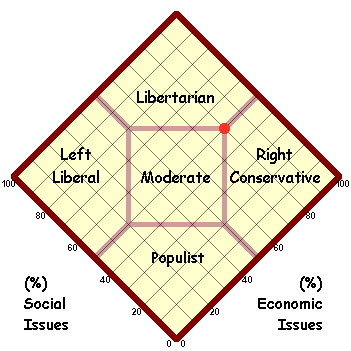
Your Score
You scored the following on the PoliticsMatch questions:
Personal Score 52%
Economic Score 82%
Where You Fit In
Where your Personal score meets your Economic score on the grid below is your political philosophy. Based on the above score, you are a Libertarian Conservative.
I didn't match up closely with any of the presidential candidates. My top two were Sam Brownback at 53% and Ron Paul at 50%. Clinton was at the bottom at 13%
Tuesday, July 03, 2007
A random rant on taxes, welfare, the rich, etc...
Through my time blogging and just engaging in political thought in my spare time, I am beginning to wonder if arguing about what is "fair" concerning taxes is useless. After all, much of it has to do with subjective opinion. It seems fair to me that someone be able to pass on their inheritance to their children, whereas others believe that it is only fair that they only pass on half their inheritance to their children, and the rest go to the government (or more euphemistically, the people).
I wish I had the luxury of being a pure libertarian, then I could say that any income redistribution is immoral. By doing so, I could easily draw a line in the sand. However, I do believe in using taxes to help those who cannot help themselves. Maybe I'm too much of a softy, but I don't want to see people dying in the gutter. At the same time, I do not see the government as an agent of social change, and I do not think the majority of charity should be done through the arm of government. Like most conservatives, I believe welfare for able-bodied people should be temporary, but I think there can be exceptions for those severely handicapped.
But by having the aforementioned position, it is hard for me to draw a line in the sand in determining just how much we should be taxed. I suppose that is what democracy is for, to figure such things out. However, in our current system, it is not how much we decide "we" should be taxed, but how much other people should be taxed. Now, some of the rich vote to tax more of the rich, what liberals call the "responsible rich". And yes, the rich can afford to pay more. But, for me personally, I have issues voting to tax certain groups outside myself. I don't know if I have any firm philosophical footing to support a flat tax right now, but I do like the idea of everyone chipping in when there is a problem, not one group asking another group to chip in. That bothers me.
Concerning the rich "paying their fair share", let's put aside the philosophy for a second. I believe from an economics standpoint, it can do more harm than good. As JFK said, "An economy hampered by restrictive tax rates will never produce enough revenues to balance our budget-just as it will never produce enough jobs or profits." (Hat tip to Glen) Even if people disagree on what the optimal rate is, we all know that, of course, it is not 100%.
Back to the philosophical side (which I said is probably useless in debate anyway), I personally don't believe people should have many guarantees. I do admit that in theory, I like the idea of universal healthcare. But I simply believe that it won't work, and I believe a host of other countries have demonstrated that it leads to care rationing.
I think we should separate the economic issues of the market and welfare. The market should be regulated to some extent concerning pollution and safety. But it seems like the left's biggest criticism of the market is its ability to provide for the poor. However, if I have to pick my battles, I would rather see a freer market with higher tax rates than a regulated market with lower tax rates. A freer market should produce more wealth anyway. If I was a progressive, I would allow for a free market, but simply tax people more. A loaf of bread costs what a loaf of bread costs. I would rather see the government tax the seller of the bread more than regulate what the loaf of bread costs. Not that I want to see extremely high taxes, but I think the economic right needs to fight the battle for the market, and let democracy sort out the tax rates. Maybe I'm saying something dangerous to economic liberty, but I think we should separate the two issues.
Finally, I prefer a measure of freedom when it comes to economics, as opposed to complete security. The left is correct in that we should not sacrifice civil liberties in our fight against terrorism. They see the importance of freedom with respect to security. The importance may not be that apparent to the right with regards to our physical security, but I think they do realize the importance when it comes to economics.
In summary, many people criticize the right for not caring about the poor. And I'll be honest, there are probably many who don't. But, as someone on the right, I still want to leave enough help so that people aren't starving. At the same time, I believe that charity is a more powerful force than government assistance, and we should still leave room for that. Also, I believe that taxing any group excessively can be counter-productive. I believe that economic liberty is intertwined with personal liberty.
Current top 10 albums
My top 10 albums changes from time to time, based on what I'm listening to. Here is my list for right now.
1. U2 - How to Dismantle an Atomic Bomb
Overall, a complete album experience.

2. U2 - Achtung Baby
This maybe the actual best album of U2's career, but I'm fancying #1 right now.
3. U2 - The Joshua Tree
Almost a perfect album. What makes this album so great is that it contains the songs everyone knowns ("With or Without You", "I Still Haven't Found What I'm Looking For), but the other songs not played on the radio are just as good. U2 is the king of 2nd-tier songs.
4. Belle and Sebastian - The Life Pursuit
I'm probably the only person who listens to this group who is a registered Republican. The wide variety of songs here would make one thing this is a various artists compilation album.
5. Beck - Sea Change
This album is simply amazing. Nothing like Becks other stuff. Good for those who like bluesy music with a twang.
6. Fiona Apple - Extraordinary Machine
Fiona's least accessible album, but probably her best. It's disappointing that radio chose to play "Oh Sailor" when it's probably the 10th best song on the album.
7. The Innocence Mission - Glow
I'm not sure why, but I tend to think of the early 90s version of the band as a female U2. This band has become more gentle and folksy, which some people like, but I prefer the more rockin' albums like this one.
8. Various Artists - The Empire Records Soundtrack
It seems like cheating to put a compilation album here, but this has a great collection of the non-aggressive 90s alternative bands, such as Better than Ezra, Cranberries, Gin Blossoms, etc...
9. The Elms - Chess Hotel
I reviewed this album in an earlier post.
This is a CCM band that sounds more like something on the classic rock station.

10. Bleach - Again, for the First Time
Bleach is a great Christian punk band that's no longer around. For some reason, bands like these are overshadowed in CCM.
1. U2 - How to Dismantle an Atomic Bomb
Overall, a complete album experience.
2. U2 - Achtung Baby
This maybe the actual best album of U2's career, but I'm fancying #1 right now.
3. U2 - The Joshua Tree
Almost a perfect album. What makes this album so great is that it contains the songs everyone knowns ("With or Without You", "I Still Haven't Found What I'm Looking For), but the other songs not played on the radio are just as good. U2 is the king of 2nd-tier songs.
4. Belle and Sebastian - The Life Pursuit
I'm probably the only person who listens to this group who is a registered Republican. The wide variety of songs here would make one thing this is a various artists compilation album.
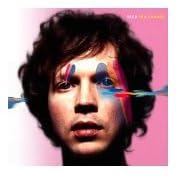
5. Beck - Sea Change
This album is simply amazing. Nothing like Becks other stuff. Good for those who like bluesy music with a twang.
6. Fiona Apple - Extraordinary Machine
Fiona's least accessible album, but probably her best. It's disappointing that radio chose to play "Oh Sailor" when it's probably the 10th best song on the album.
7. The Innocence Mission - Glow
I'm not sure why, but I tend to think of the early 90s version of the band as a female U2. This band has become more gentle and folksy, which some people like, but I prefer the more rockin' albums like this one.
8. Various Artists - The Empire Records Soundtrack
It seems like cheating to put a compilation album here, but this has a great collection of the non-aggressive 90s alternative bands, such as Better than Ezra, Cranberries, Gin Blossoms, etc...
9. The Elms - Chess Hotel
I reviewed this album in an earlier post.
This is a CCM band that sounds more like something on the classic rock station.
10. Bleach - Again, for the First Time
Bleach is a great Christian punk band that's no longer around. For some reason, bands like these are overshadowed in CCM.
Subscribe to:
Posts (Atom)