ESPN.com ranked every 119 Division 1-A college football program over the last 10 years. Not surprisingly, the USC Trojans ranked at the top. It's a pretty good list overall, though I'm surprised to see Florida State and Miami in the top 10. However, I have to remember that this is over the last 10 years, not the last 2.
I was glad to see Texas at number 3, and my beloved Oklahoma State Cowboys were tied at 56 with the Air Force Academy. I hope both my old home team and my new home team improve.
The only thing that bothered me about the rankings is they kept mentioning that USC was "a few seconds away from a third [national championship]." Yes, going to a championship game, even if you don't win, should count for something. But when it comes to the national championship game, or any game for that matter, it is either a win or a loss. In my view, closeness doesn't count.
I'm excited for the next football season. I think my two favorite teams, Texas and Oklahoma State, will improve. I was sad to see Texas implode last year near the end of the season, but they have gotten the OU monkey off their back (not to say it is a guaranteed win, but that the psychological blocks of a 5-year slump should be over), so I see their potential as limitless. Oklahoma State will depend heavily on their quarterback, if he can play consistently.
I am not an OU fan, but I thought they got the shaft, having to forfeit their wins from the 2005 season. They dismissed the crooked players as soon as they found out, so at the most, they should have gotten a warning.
I suppose it is early to talk about college football, but what else am I going to talk about when it comes to sports (other than Michael Vick, Barry Bonds, and the crooked NBA ref)?
Friday, July 27, 2007


Wednesday, July 25, 2007
Health care and health coverage
Without getting too much into details, I wanted to touch on the subject of health care and health coverage, primarily the fact that the two are different. Many conservatives/libertarians, Cannon, for one, argue that the goal is not to provide increasing coverage to people, but health care in increasing coverage and quantity. Coverage alone does not guarantee access to health care, only a waiting line in many cases.
Conservatives/libertarians argue that getting the government out of health care will make health care cheaper and of higher quality, resulting in fewer people uncovered. Still, the question remains, what about those people, however small or large the group may be, that are not covered? Some libertarians will argue that charity or the doctors themselves will eat up the cost of caring for them, whereas conservatives and more practical libertarians agree that those who truly cannot afford health care would indeed be cared for under government programs. Liberals will argue that it is cheaper to insure those people in the first place, as opposed to paying catastrophic expenses, and it is a valid point. However, many claim that government getting involved in coverage is inherently more intrusive and expansive as opposed to taking care of costs for the poor when they arise.
Anyway, my main point is that coverage and care are two different things. Access to coverage does not equal access to care. The goal should be to increase availability and quality of care, which I believe can be done through less government involvement. And I think we can do so without leaving the poorest in the gutter.
Friday, July 20, 2007
Make your own all-star band
Lee is back to blogging, and he has a post where you can create your own all-star band, inspired by the previous all-star band the Traveling Wilburys. See his post for more details and rules. My dream band is (not sure about spelling on all):
Bono (U2)
Pete Townshend (The Who)
John Frusciante (Red Hot Chili Peppers)
John Rzeznik (Goo Goo Dolls)
Chris Martin (Coldplay)
I do realize that not every position is covered, as I am not sure any of these guys can play the drums. If I had to have a drummer, it would probably be the guy from Rush.
Be sure to visit Lee and participate.
Wednesday, July 18, 2007
The cheap and easy way to argue
Over in another blog, the issue of homosexuality is being argued, as in, whether or not the Bible actually condemns it. Dan, being the good man that he is, uses a reasoned argument in the negative, although I disagree with him. However, I worry about poor Dan. He probably puts a bit of time and energy into his arguments. Doesn't he know it would be so much easier if he chalked the conservative Biblical view to homophobia, like another commenter on the blog?
Similarly, in the immigration debate, a few of those who think illegal immigrants should have amnesty or have access to free government services simply cry "racist" to their opponents. They could argue about the costs/benefits associated with deportation, but the former method is so much easier and takes less brainpower.
Of course, the effectiveness of emotional arguments and name calling should be seriously questioned, but sometimes people don't want to change minds, they just want to get an emotional charge out of their self-righteous ramblings.
Wednesday, July 11, 2007
What is the dividing line?
There has been much discussion on Neil Simpson's blog concerning what various denominations, particularly the liberal ones, believe. I would easily consider myself a conservative Christian, in the sense that I tend to have the mainstream Christian beliefs. More and more denominations tend to become liberal, in the sense that they have a more liberal as opposed to literal interpretation of the Bible, and they have a more liberal view on cultural issues such as homosexuality/transgenderism.
It was discussed on the blog what the dividing points are. Although I don't think anyone came out and explicitly said it, I think many would agree with me that the central issue of Christianity is, of course, Christ. The nature of our belief in Christ is what separates Christianity from other religions/spiritual viewpoints. John states in his first epistle that
I don't want to say anything incorrect here. If I'm missing something major, let me know. Any inputs are welcome.
It was discussed on the blog what the dividing points are. Although I don't think anyone came out and explicitly said it, I think many would agree with me that the central issue of Christianity is, of course, Christ. The nature of our belief in Christ is what separates Christianity from other religions/spiritual viewpoints. John states in his first epistle that
" 20But you have an anointing from the Holy One, and all of you know the truth. 21I do not write to you because you do not know the truth, but because you do know it and because no lie comes from the truth. 22Who is the liar? It is the man who denies that Jesus is the Christ. Such a man is the antichrist—he denies the Father and the Son. 23No one who denies the Son has the Father; whoever acknowledges the Son has the Father also."There are a wide ranges of beliefs within the body of Christianity, but when people deny that Jesus was indeed the Messiah, but just a good person, or another prophet, those beliefs fall outside the realm of Christianity. This is not an endorsement in any way of all of [theologically] liberal Christians' beliefs. And keep in mind, I am far from a theological scholar. It does appear to me, though, that the Bible continually focuses on belief in Christ as the central point, as stated in John 3:16.
16"For God so loved the world that he gave his one and only Son, that whoever believes in him shall not perish but have eternal life.Some may argue that a belief in the entire Bible is necessary to be a Christian. I don't quite agree, because Jesus says that we should believe in Him, not the Bible. However, it would seem dangerous to question the authority and authenticity of the Bible, because it could make us question the gospels, and the entire story of Jesus. However, when talking to non-believers, I would tend to focus on the story and evidence of Christ's life and resurrection and then let the rest of the Bible fall from there.
I don't want to say anything incorrect here. If I'm missing something major, let me know. Any inputs are welcome.
Bible Translations
One of my friends gave me a NET Bible, which is a fairly new translation of the Bible. I still prefer the NIV, but I really enjoy using the Bible study tools on Bible.org, which is an accompaniment to the NET Bible. The notes inside the physical Bible are minimal, but the online resource has more extensive notes. I've noticed that I prefer notes that focus on what the actual words mean with respect to the original Greek or Hebrew. I have a Life Application Bible that has quite a bit of notes, but lately, I've preferred notes/commentary of a more academic nature.
I also like notes on the Greek/Hebrew as they give transparency to the translation process. I don't think many Bible versions have sinister intent during the translation process, but it is nice to know as much about the original copies of scripture as possible.
In general, I think reading a couple different translations during study time is good, as I have noticed that I sometimes pick up on things that I did not before.
Apparently, there is a group of people who believe that the King James Version is the only acceptable translation, and is, in fact, divinely inspired. Some people call this the King James Only Movement. I've checked out various websites purporting this idea. Some criticisms use circular reasoning, in that they compare other versions against the KJV, and point out that they omit test included in the KJV. I respect their views, but I haven't found any convincing reasoning why one should put faith in the KJV as opposed to other translations. The more serious scholars can also look at earlier biblical text to evaluate a translation.
Thursday, July 05, 2007
Yet another political quiz
Speakout.com has a nice quiz on political issues. I prefer this quiz over many others for a couple different reasons.
The same quiz can be used for multiple things, such as your match with various Presidential candidates or your political philosophy. The first part of the quiz has you select what you are looking for. You can simply hit the 'Back' button, select a new gauge, and simply resubmit your questions without re-answering everything.
You can click on questions to get more details. Some of the questions may not be clear, so you can click and find out what they are really asking.
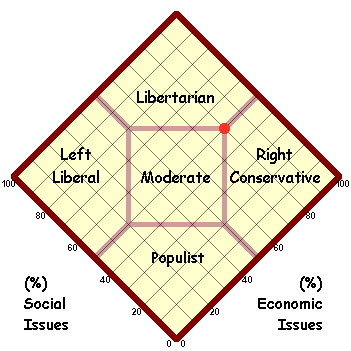
Here is my score
I didn't match up closely with any of the presidential candidates. My top two were Sam Brownback at 53% and Ron Paul at 50%. Clinton was at the bottom at 13%
The same quiz can be used for multiple things, such as your match with various Presidential candidates or your political philosophy. The first part of the quiz has you select what you are looking for. You can simply hit the 'Back' button, select a new gauge, and simply resubmit your questions without re-answering everything.
You can click on questions to get more details. Some of the questions may not be clear, so you can click and find out what they are really asking.
Here is my score
Your Score
You scored the following on the PoliticsMatch questions:
Personal Score 52%
Economic Score 82%
Where You Fit In
Where your Personal score meets your Economic score on the grid below is your political philosophy. Based on the above score, you are a Libertarian Conservative.
I didn't match up closely with any of the presidential candidates. My top two were Sam Brownback at 53% and Ron Paul at 50%. Clinton was at the bottom at 13%
Tuesday, July 03, 2007
A random rant on taxes, welfare, the rich, etc...
Through my time blogging and just engaging in political thought in my spare time, I am beginning to wonder if arguing about what is "fair" concerning taxes is useless. After all, much of it has to do with subjective opinion. It seems fair to me that someone be able to pass on their inheritance to their children, whereas others believe that it is only fair that they only pass on half their inheritance to their children, and the rest go to the government (or more euphemistically, the people).
I wish I had the luxury of being a pure libertarian, then I could say that any income redistribution is immoral. By doing so, I could easily draw a line in the sand. However, I do believe in using taxes to help those who cannot help themselves. Maybe I'm too much of a softy, but I don't want to see people dying in the gutter. At the same time, I do not see the government as an agent of social change, and I do not think the majority of charity should be done through the arm of government. Like most conservatives, I believe welfare for able-bodied people should be temporary, but I think there can be exceptions for those severely handicapped.
But by having the aforementioned position, it is hard for me to draw a line in the sand in determining just how much we should be taxed. I suppose that is what democracy is for, to figure such things out. However, in our current system, it is not how much we decide "we" should be taxed, but how much other people should be taxed. Now, some of the rich vote to tax more of the rich, what liberals call the "responsible rich". And yes, the rich can afford to pay more. But, for me personally, I have issues voting to tax certain groups outside myself. I don't know if I have any firm philosophical footing to support a flat tax right now, but I do like the idea of everyone chipping in when there is a problem, not one group asking another group to chip in. That bothers me.
Concerning the rich "paying their fair share", let's put aside the philosophy for a second. I believe from an economics standpoint, it can do more harm than good. As JFK said, "An economy hampered by restrictive tax rates will never produce enough revenues to balance our budget-just as it will never produce enough jobs or profits." (Hat tip to Glen) Even if people disagree on what the optimal rate is, we all know that, of course, it is not 100%.
Back to the philosophical side (which I said is probably useless in debate anyway), I personally don't believe people should have many guarantees. I do admit that in theory, I like the idea of universal healthcare. But I simply believe that it won't work, and I believe a host of other countries have demonstrated that it leads to care rationing.
I think we should separate the economic issues of the market and welfare. The market should be regulated to some extent concerning pollution and safety. But it seems like the left's biggest criticism of the market is its ability to provide for the poor. However, if I have to pick my battles, I would rather see a freer market with higher tax rates than a regulated market with lower tax rates. A freer market should produce more wealth anyway. If I was a progressive, I would allow for a free market, but simply tax people more. A loaf of bread costs what a loaf of bread costs. I would rather see the government tax the seller of the bread more than regulate what the loaf of bread costs. Not that I want to see extremely high taxes, but I think the economic right needs to fight the battle for the market, and let democracy sort out the tax rates. Maybe I'm saying something dangerous to economic liberty, but I think we should separate the two issues.
Finally, I prefer a measure of freedom when it comes to economics, as opposed to complete security. The left is correct in that we should not sacrifice civil liberties in our fight against terrorism. They see the importance of freedom with respect to security. The importance may not be that apparent to the right with regards to our physical security, but I think they do realize the importance when it comes to economics.
In summary, many people criticize the right for not caring about the poor. And I'll be honest, there are probably many who don't. But, as someone on the right, I still want to leave enough help so that people aren't starving. At the same time, I believe that charity is a more powerful force than government assistance, and we should still leave room for that. Also, I believe that taxing any group excessively can be counter-productive. I believe that economic liberty is intertwined with personal liberty.
Current top 10 albums
My top 10 albums changes from time to time, based on what I'm listening to. Here is my list for right now.
1. U2 - How to Dismantle an Atomic Bomb
Overall, a complete album experience.

2. U2 - Achtung Baby
This maybe the actual best album of U2's career, but I'm fancying #1 right now.
3. U2 - The Joshua Tree
Almost a perfect album. What makes this album so great is that it contains the songs everyone knowns ("With or Without You", "I Still Haven't Found What I'm Looking For), but the other songs not played on the radio are just as good. U2 is the king of 2nd-tier songs.
4. Belle and Sebastian - The Life Pursuit
I'm probably the only person who listens to this group who is a registered Republican. The wide variety of songs here would make one thing this is a various artists compilation album.

5. Beck - Sea Change
This album is simply amazing. Nothing like Becks other stuff. Good for those who like bluesy music with a twang.
6. Fiona Apple - Extraordinary Machine
Fiona's least accessible album, but probably her best. It's disappointing that radio chose to play "Oh Sailor" when it's probably the 10th best song on the album.
7. The Innocence Mission - Glow
I'm not sure why, but I tend to think of the early 90s version of the band as a female U2. This band has become more gentle and folksy, which some people like, but I prefer the more rockin' albums like this one.
8. Various Artists - The Empire Records Soundtrack
It seems like cheating to put a compilation album here, but this has a great collection of the non-aggressive 90s alternative bands, such as Better than Ezra, Cranberries, Gin Blossoms, etc...
9. The Elms - Chess Hotel
I reviewed this album in an earlier post.
This is a CCM band that sounds more like something on the classic rock station.

10. Bleach - Again, for the First Time
Bleach is a great Christian punk band that's no longer around. For some reason, bands like these are overshadowed in CCM.
1. U2 - How to Dismantle an Atomic Bomb
Overall, a complete album experience.

2. U2 - Achtung Baby
This maybe the actual best album of U2's career, but I'm fancying #1 right now.
3. U2 - The Joshua Tree
Almost a perfect album. What makes this album so great is that it contains the songs everyone knowns ("With or Without You", "I Still Haven't Found What I'm Looking For), but the other songs not played on the radio are just as good. U2 is the king of 2nd-tier songs.
4. Belle and Sebastian - The Life Pursuit
I'm probably the only person who listens to this group who is a registered Republican. The wide variety of songs here would make one thing this is a various artists compilation album.
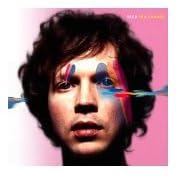
5. Beck - Sea Change
This album is simply amazing. Nothing like Becks other stuff. Good for those who like bluesy music with a twang.
6. Fiona Apple - Extraordinary Machine
Fiona's least accessible album, but probably her best. It's disappointing that radio chose to play "Oh Sailor" when it's probably the 10th best song on the album.
7. The Innocence Mission - Glow
I'm not sure why, but I tend to think of the early 90s version of the band as a female U2. This band has become more gentle and folksy, which some people like, but I prefer the more rockin' albums like this one.
8. Various Artists - The Empire Records Soundtrack
It seems like cheating to put a compilation album here, but this has a great collection of the non-aggressive 90s alternative bands, such as Better than Ezra, Cranberries, Gin Blossoms, etc...
9. The Elms - Chess Hotel
I reviewed this album in an earlier post.
This is a CCM band that sounds more like something on the classic rock station.

10. Bleach - Again, for the First Time
Bleach is a great Christian punk band that's no longer around. For some reason, bands like these are overshadowed in CCM.
Friday, June 29, 2007
Thoughts on the Democratic Debate
This is the first debate I caught on TV, because my wife was flipping through the channels and wanted to watch. I only saw part of the debate, but here are my random thoughts.
1) I really like this Gravel guy. I like how he went against the grain and called for a replacement of the income tax with a larger sales tax. Even if you don't agree, it's always nice to hear something different.
2) As expected, every other candidate talked about the rich paying their fair share of taxes. I can see their point about capital gains tax being lower than the income tax, and how that doesn't seem right. My response would be lower the income tax, but I have a feeling they have the opposite solution.
However, I would like both sides to quit talking about what is "fair" and using their subjective opinions to when it comes to arguing for lower/higher taxes. Both sides will just talk past each other. Conservatives do contend that lower taxes produce higher revenues. I would like to see Democrats respond to that.
3) I think every candidate harped on the failure of Katrina. It will be a helpful issue to the Democratic nominee, as they will suggest more spending and programs, but it won't exactly hurt the Republican nominee, as it will not be Bush running again.
4) Obama may have responded well to the questions, but I think he was upstaged by the more fiery candidates, such as Kucinich and Clinton. Obama is more of a calm, collected sort of guy, which isn't a good/bad thing necessarily. I just know that he didn't stick out the most in my mind after the debate was over.
5) Republicans need to come up with a good plan to fix healthcare that will resonate with voters. The universal healthcare approach will have massive appeal to voters, so they need to come up with an alternative quickly.
Another advantage of school choice
The Cato Blog makes a good point. There are other ways to achieve racial integration rather than the direct methods struck down by the Supreme Court yesterday. One way is school choice. Imagine a system where poor minority children wouldn't be stuck with their inner-city schools. Such a system would require less government involvement, something many aren't ready for.
Thursday, June 28, 2007
The separation of the sacred and secular
I have noticed that in art, particularly in music, there is a strong separation between CCM (Christian Contemporary Music) and secular music. This line is being blurred somewhat, with some crossover artists, but it seems that someone is a "Christian" artist, or they are not.
My question is this, is this a good thing?
The reason I ask is that I am not sure this separation always existed. Da Vinci painted religious themed portraits like The Last Supper, but he wasn't known as a "Christian" artist, and he painted non-religious things as well. People didn't ask "Oh, he painted The Last Supper, is he a Christian artist now?" Classic composers (of whom I know little about) would compose works inspired by their faith, but sometimes they would not be. It seems that there were many classic poets and authors (correct me if I am wrong, as I left all my poetry books at home) would speak on spiritual themes, sometimes they would not. There was not a question of whether they belonged to the Christian genre or not.
This may be a good thing, because much of secular culture is quite distant from Christian values, based on the things they glorify. Maybe as the secular becomes more profane, this distancing is inevitable.
Why would it be a bad thing?
Perhaps it has to do with the overall quality of art. I will be honest, there is much CCM I don't care for right now; much of it seems second-rate. Maybe it's just an issue with me though. But I notice that many great artists are those that are Christian, but not in the "Christian" genre. U2 is the most glaring example. Three of the four members are Christian, and many songs are very spiritual. Another lesser known band is the Innocence Mission that has many spiritual songs as well, and even has an album of hymns. Some of the highest quality CCM bands are now crossing over, or at least have a foot in the mainstream, such as Switchfoot or Skillet.
So, I don't know if my concerns have any foundation. Basically, I have noticed that much great art of the past was influenced by Christianity but was not in a genre separate from everything else. Today, I notice a distinct separation in many cases, and it seems that many times the "Christian" side is inferior, whereas those artists that may have some mainstream involvement are the superior bands. (To be fair though, it is understandable that the creme of the Christian crop would get mainstream attention). At the same time, I know we, as Christians, are called to stand out and not blend in.
As a final note, there seems to be a distinct exception in the genre of country music. Carrie Underwood has a hit called "Jesus, Take the Wheel" but there is not a debate on whether she is a Christian artist. Garth Brooks will have overtly religious songs on his album, but at the same time sing about a woman killing her unfaithful husband (I don't say that to be critical, as I don't think he is glorifying or justifying murder, I am just illustrating the main point of my post). There does not seem to be a big "Christian country" genre. What is so different about country?
Tuesday, June 19, 2007
Off for about a week
I'll be gone for about a week visiting family, so no posts for a while, which may not be unusual as I sometimes go a week without blogging. Have a good weekend.
Conservatism, liberalism, and the Gray-Haired Old White Man
The concept of a modern day Noah's Ark story found in Evan Almighty had fascinated me. After all, the original account deals with God wiping out the earth because of our sin. The idea of a story about God punishing sinful man, well, it just seems out of place in Hollywood.
Of course, it depends what the sin is. Now, I have not seen the movie, but I've read a brief synopsis in the Washington Post review. This is not an in depth analysis, otherwise I would wait till I saw the movie. But the sin that the movie focuses on is not surprising. The post says...
But corrupt politicians are not the only thing wrong with the world either. For instance, there is the dissolution of families, promiscuous sex, and the marketing of sex on TV. However, I don't think a movie about the bad guys being people who sleep around a lot would catch on as one in which the bad guys are evil businessmen destroying the environment.
This is not to downplay the latter, but the concept of the movie does point out a divide between what bothers liberals and conservatives. Now, this post is not an attempt to invalidate or discredit the beliefs of either side, it is only an attempt at an analysis of what each side values. I would welcome any input from anyone regarding these views.
Liberalism, it seems, has the spark of youthful rebellion. Liberalism is all about challenging the establishment. It is rebelling against the Gray-Haired Old White Man. (I don't say "White" to give this any racial overtones, I am just mentioning it because if you look at most people in power, well, that's what they look like.) Liberals like to leave people alone in their personal lives (again, in theory, I think the DP has done the opposite many times) but focus more on regulating economic activity. Regulating economic activity is essentially telling the Gray-Haired Old White Man what to do.
Also, part of liberalism is the avoidance of being the Gray-Haired Old White Man. Let's take abortion for instance. Saying "No" to some poor woman, maybe a minority, just doesn't have the same zing as saying "No" to the rich and powerful. Telling someone who isn't in power "you can't do that" is so Gray-Haired Old White Man, it's so...conservative.
Conservatives, on the other hand, well, most often they are the Gray-Haired Old White Man, or at least the favored son of the Gray-Haired Old White Man. Perhaps the conservative is the good son who went to college and has a nice job in a skyscraper, and the liberal is the 2nd-born son who dropped out of college and builds houses in Ecuador.
Jesus Himself could be seen as a liberal, in the sense that He also challenged the rich and powerful. He purposely upset the religious establishment, the Pharisees, and he had no qualms about upsetting the governmental authorities, although he had no political ambitions. But Jesus was also set on challenging us as the individual. He not only challenged the Pharisees taking God's name in vain, but he also challenged the woman at the well who had five previous husbands and was living with a guy. He did so out of love, and not a condemning tone, but he still made her feel uncomfortable.
In the political sense, both appeal to government power more than I would like. But I think in a cultural sense, in the sense of what is right and wrong, I think both groups have their strengths. Many conservatives can learn from liberals in regarding those who are oppressed and corruption among the rich and powerful. At the same time, I think liberals need to look more at "conservative" type issues and realize that maybe the fracture of the family structure may be leading to things like poverty and inner-city crime.
Also, sometimes Christianity and our current modern American philosophy may agree. Both scorn the abuse of power by the Gray-Haired Old White Man. But Christianity goes further. It is not just telling Gray-Haired Old White Man, "Hey, quit destroying our earth" or "Hey, quit oppressing the poor!" but it is telling the suave 20-something year old man "Hey, keep it in your pants!" or telling the 30-something housewife "Hey, stick with your husband and work it out, even if you think the guy in the next office truly 'gets you'!" Christianity is not only about exterminating the evil found in the ranks of the rich and powerful, it is looking at ourselves and finding the evil within us.
Of course, it depends what the sin is. Now, I have not seen the movie, but I've read a brief synopsis in the Washington Post review. This is not an in depth analysis, otherwise I would wait till I saw the movie. But the sin that the movie focuses on is not surprising. The post says...
the movie has a modern theme about saving the environment from corrupt politicians and businessman looking to profit by diminishing green meadows and animal habitats.Now, of course many people can get on board with this idea. I don't like corrupt politicians and businessmen either.
But corrupt politicians are not the only thing wrong with the world either. For instance, there is the dissolution of families, promiscuous sex, and the marketing of sex on TV. However, I don't think a movie about the bad guys being people who sleep around a lot would catch on as one in which the bad guys are evil businessmen destroying the environment.
This is not to downplay the latter, but the concept of the movie does point out a divide between what bothers liberals and conservatives. Now, this post is not an attempt to invalidate or discredit the beliefs of either side, it is only an attempt at an analysis of what each side values. I would welcome any input from anyone regarding these views.
Liberalism, it seems, has the spark of youthful rebellion. Liberalism is all about challenging the establishment. It is rebelling against the Gray-Haired Old White Man. (I don't say "White" to give this any racial overtones, I am just mentioning it because if you look at most people in power, well, that's what they look like.) Liberals like to leave people alone in their personal lives (again, in theory, I think the DP has done the opposite many times) but focus more on regulating economic activity. Regulating economic activity is essentially telling the Gray-Haired Old White Man what to do.
Also, part of liberalism is the avoidance of being the Gray-Haired Old White Man. Let's take abortion for instance. Saying "No" to some poor woman, maybe a minority, just doesn't have the same zing as saying "No" to the rich and powerful. Telling someone who isn't in power "you can't do that" is so Gray-Haired Old White Man, it's so...conservative.
Conservatives, on the other hand, well, most often they are the Gray-Haired Old White Man, or at least the favored son of the Gray-Haired Old White Man. Perhaps the conservative is the good son who went to college and has a nice job in a skyscraper, and the liberal is the 2nd-born son who dropped out of college and builds houses in Ecuador.
Jesus Himself could be seen as a liberal, in the sense that He also challenged the rich and powerful. He purposely upset the religious establishment, the Pharisees, and he had no qualms about upsetting the governmental authorities, although he had no political ambitions. But Jesus was also set on challenging us as the individual. He not only challenged the Pharisees taking God's name in vain, but he also challenged the woman at the well who had five previous husbands and was living with a guy. He did so out of love, and not a condemning tone, but he still made her feel uncomfortable.
In the political sense, both appeal to government power more than I would like. But I think in a cultural sense, in the sense of what is right and wrong, I think both groups have their strengths. Many conservatives can learn from liberals in regarding those who are oppressed and corruption among the rich and powerful. At the same time, I think liberals need to look more at "conservative" type issues and realize that maybe the fracture of the family structure may be leading to things like poverty and inner-city crime.
Also, sometimes Christianity and our current modern American philosophy may agree. Both scorn the abuse of power by the Gray-Haired Old White Man. But Christianity goes further. It is not just telling Gray-Haired Old White Man, "Hey, quit destroying our earth" or "Hey, quit oppressing the poor!" but it is telling the suave 20-something year old man "Hey, keep it in your pants!" or telling the 30-something housewife "Hey, stick with your husband and work it out, even if you think the guy in the next office truly 'gets you'!" Christianity is not only about exterminating the evil found in the ranks of the rich and powerful, it is looking at ourselves and finding the evil within us.
Wednesday, June 13, 2007
Our perception of God, or, a Father's Day post a little early
Last Father's Day, the pastor at my church talked about how our perception of God depended heavily upon our relationship with our earthly father. (Disclaimer: I wasn't at church then, I can't remember why, but my wife relayed the central themes).
It's an interesting idea. What is our perception of God? Do we think of Him as some angry deity ready to smite us whenever we mess up? Or do we think of God as absent? Someone who cares not for the petty details of our life and leaves us to our own devices.
I think many of us Christians know in our head what God is like. A loving God slow to anger, forgiving yet just, and all that stuff. But I think sometimes in our hearts we picture Him much differently. Related to that picture is a desire that He be more this or that.
So what is our perception of God? It may illuminate our relationship with our father. Look at the relationship with our father, it may illuminate our perception of God.
I've got a big responsibility to ensure that my son will have a balanced and accurate view of God, not just in his head but in his heart.
Monday, June 11, 2007
My idea for a reality show
I was watching a Simpsons episode called "Mr. Lisa goes to Washington", in which Lisa wins an essay contest about the greatness of America, but quickly becomes disillusioned when she sees the corruption in Washington.
The show made me think about politicians in general, and it seems that even the honest ones have probably made some moral compromises along the way. Not that I would consider going into politics, but even if I wanted to, I am afraid my Christianity would be compromised. But somebody's gotta do the job.
A common theme in various Christian men's ministries is that of accountability in many areas of life, including sexual purity. The idea is to have men keep each other accountable, where they can talk about their daily struggles and their progress in their spiritual life. Intertwined with accountability is the whole idea of openness, keeping one's daily activities and interactions in the light. The biggest thing tripping up many Christian men is the internet. I use a program called Covenant Eyes that keeps my surfing activities in the open.
I think Christian men should have at least one person keeping them accountable, and their are many verses supporting this idea. (As well as women, I am just speaking from a man's point of view).
So if accountability and openness is required to be a good Christian person, what about our elected representatives?
So this idea came to me. What if some, or every representative had their own reality show? The gist of most reality shows is that the camera follows a celebrity around and captures the inane details of their life. What if they did the same for politicians? The cameras would follow every lunch with a lobbyist, every interaction with their secretary, their involvement in each legislative session. Not everything would make the show, of course, but the juiciest details would.
I'm sure the idea would never go over. But if I ever wanted to be involved in politics, I would want all my interactions to be out in the open for everyone to see. I'm just not that virtuous.
Difference between big and small government folks
Big government folks, whether they be conservative or liberal, are optimistic. They put their faith in politicians, that they will always do the right thing. Limited government folk are different in that they prepare for the worst-case scenario, that the worst sort of people will be in charge.
Friday, June 08, 2007
Understanding the scientific origins of the universe is way overrated. Or is it? Let the parents decide.
There is an interesting discussion over at Glen Dean's blog about school choice. One of his money quotes is
I agree with Glen in that parents should have the primary role in what their children are taught. If a central federal office or court has the power to enforce teaching with which we agree, it has the same power to do so when we don't disagree. Liberals may think they have more to gain with a centralized school system, but there could still be governors or courts that think creationism is the way to go.
Additionally, let's say evolution does provide a sufficient framework for explaining the universe. Okay, fine, but is someone really going to miss out and not be able to function in society if they don't learn about it? From a scientific perspective, people give the origins of the universe too much credit. I went through a whole set of college coursework without touching a biology class, as it was not necessary or related to my major. But even in high school, when I did take a biology class, we didn't really touch on evolution too much, but that doesn't mean I didn't learn (and quickly forgot) the processes of mitosis, meiosis, photosynthesis, and all that other stuff. Not only is an understanding of evolution unnecessary to basic functioning in society, but someone can still have a good grasp of the sciences without going into the subject. In the case that someone wanted to go into academia in the life sciences,the desired college program can determine if evolutionary understanding is necessary. Already, college programs decide on entry requirements typically beyond high school graduation requirements anyway.
But I'm only looking at it from a purely utilitarian point of view. After all, reading classic works or learning the finer details of our American government are not things I apply everyday in my particular line of work, but I am still glad I learned those things, and I hope my children do as well.
The point is, I, as a parent, should determine if learning the scientific origins of the universe is even that important in the first place. The same should go for other areas of education as well.
Christians who believe that God created the heavens and the earth, and want their children to be taught that, are not necessarily the enemies of science. All they really ask is that they have a little say in what their children are taught. After all, the children do belong to them, not the state.. Another commenter made a reasonable point in the second paragraph
I disagree that the topic is freedom. I really am frightened by the prospect of millions of ignorant kids growing into adulthood completely lacking some basic knowledge about how the world works. Furthermore, the South and pockets of the midwest, seem to be havens for this sort of thinking. Left unchecked, the day will come when we'll have pockets of ignorance--sorta like how things were in the last century.I wanted to raise a couple of points.
Parents can teach their kids whatever they want, but there should still be certain standards of education. Kids need to at least be exposed to real science. What they choose to do with that knowledge is their own business.
I agree with Glen in that parents should have the primary role in what their children are taught. If a central federal office or court has the power to enforce teaching with which we agree, it has the same power to do so when we don't disagree. Liberals may think they have more to gain with a centralized school system, but there could still be governors or courts that think creationism is the way to go.
Additionally, let's say evolution does provide a sufficient framework for explaining the universe. Okay, fine, but is someone really going to miss out and not be able to function in society if they don't learn about it? From a scientific perspective, people give the origins of the universe too much credit. I went through a whole set of college coursework without touching a biology class, as it was not necessary or related to my major. But even in high school, when I did take a biology class, we didn't really touch on evolution too much, but that doesn't mean I didn't learn (and quickly forgot) the processes of mitosis, meiosis, photosynthesis, and all that other stuff. Not only is an understanding of evolution unnecessary to basic functioning in society, but someone can still have a good grasp of the sciences without going into the subject. In the case that someone wanted to go into academia in the life sciences,the desired college program can determine if evolutionary understanding is necessary. Already, college programs decide on entry requirements typically beyond high school graduation requirements anyway.
But I'm only looking at it from a purely utilitarian point of view. After all, reading classic works or learning the finer details of our American government are not things I apply everyday in my particular line of work, but I am still glad I learned those things, and I hope my children do as well.
The point is, I, as a parent, should determine if learning the scientific origins of the universe is even that important in the first place. The same should go for other areas of education as well.
Wednesday, June 06, 2007
When it comes to regulation, we should look at all sides of the story
I was watching a CBS News report about the poor in Mississippi. It spoke about a poor black girl who had problems receiving Medicare due to some bureaucratic red tape. Because of some new regulations, she had to fill out additional paperwork and have a face-to-face meeting 30 miles away, and she had no care.
Fair enough. No doubt the regulations were probably passed to ensure that people were not bilking the system, but every action has unintended consequences.
But let's say the story was slightly different. Let's say this person, or someone similar, was fortunate enough to have a little money saved up and was trying to start a business, like a manicure shop or a restaurant. And let's say, due to some new regulations, she had to fill out additional paperwork, or go to some class 30 miles away to get her license at least once a year.
For some reason, I don't imagine many media news outlets would report on such a story.
Regulations affect every area of our life, but why do we primarily hear reports about it when it comes to things such as getting food stamps or Medicare? Why don't we hear about the endless regulations that get in the way of people who are trying to make a living for themselves? Regulations don't just affect rich white men running large corporations; they affect the black women in Minnesota who simply want to make money braiding hair without having to pay $15,000 in tuition.
Here are my points.
1) Many people, including the media, tend to have a certain bias when it comes to regulations. Additional paperwork or any work at all when it comes to getting direct things from the government seem to get the most attention.
2) With regulation, there are multiple sides to the story. Like the red tape of Medicare that makes it harder for people to get treatment, red tape that is done in the interest of consumer protection makes it harder for the average person to start a business. The Institute for Justice covers such cases. With every law there can be good and bad consequences.
3) Regulation on the local or state level can make it too difficult for the poor to start businesses. State licensing and the like are usually passed by established, large corporations already in power that make it harder for new, smaller competitors to get on their feet. Eliminating some of these regulations should be something with which conservatives, libertarians, and liberals can all get on board.
Tuesday, June 05, 2007
More music reviews

Skillet - Comatose. Skillet is one band who hasn't watered down their sound, despite being at the forefront of Christian Contemporary Music. I like this album better than the previous one, Collide, which was more on the edgy side. The songs are a bit more accessible without being compromising. The album builds a little upon the song "Collide" in the last album, by incorporating stringed instruments in a few songs. Overall, a very good album. My one complaint about this album and Skillet in general is that they simply make their songs too long. They have a tendency to really hammer the choruses into your brain. I recommend this album for fans of hard Christian rock. Click here to preview their tracks.
 Everyday Sunday - Stand Up
Another great CCM band with a fun punk-rock (that is, modern punk in the style of Green Day, Blink 182, etc...) style. They have actually released 2 albums since this release, Anthems for the Imperfect and Wake Up, Wake Up! which I will check out when I get the opportunity. Here are some track samples.
Monday, June 04, 2007
Hey kids, you like the rock and roll? Here are some album reviews

The Elms - The Chess Hotel. I became familiar with The Elms through hearing a couple of their songs on contemporary Christian radio stations. I had some free CDs to buy with my BMG account, and decided to give them a try. Even though I didn't hear a track from this album previously, I was told somewhere that this album was heavily influenced by 60s groups like the Rolling Stones. I had to give the album a try.
Any fans of acoustic and/or classic rock will love this album, as it is ripe with various influences. I thought I detected some Black Crowes and Tom Petty. Interestingly enough, their website states that the producer was "the engineering mind behind brilliant albums from Tom Petty, The Posies, The Black Crowes, and scores of others..." The album, like many in CCM today, is not overtly spiritual, but to me, I think a spiritually-neutral album is better than one spiritually corrosive. I highly recommend this album for any lovers of pure rock and/or roll. Click here to check out some of their tracks.
eHarmony being sued
Hat tip to Neil Simpson for this bit of news. eHarmony is being sued for excluding gays.
Here are a couple of my thoughts.
1) This is a prime, prime example of where we should let the market sort it out. If someone wants to start an all-gay dating service, so be it. That is their right. If someone wants to start an all-straight dating service, so be it.
As much as (some) liberals detest the free market, the free market is what allows people to live according to their own moral code. Think about it. All dating services could be forced to conform to a universal set of government laws, or they could all be free to operate as they wish, satisfying the diversity of consumers out there.
2) Many liberals are truly liberals, they believe that people should be free to live as they please. Other liberals, however, are not. They are all about coercion. These are the liberals who think doctors should be forced to perform abortions against their conscience, enforce campus hate speech codes, and in this case, force a business to accommodate lifestyles with which they disagree. Don't let the "live and let live" stuff fool you. These people are all about forcing others to do things against their conscience to accommodate their own lifestyle.
Funniest Quote of the Week (So Far)
Josh says in reference to Fred Thompson "he'll have the votes of every member of the cast of Law & Order, and that show's been on for a long time."
Thursday, May 31, 2007
For you computer nerds: Windows vs. Linux
I don't know how many of you out there use operating systems other than Microsoft Windows. For personal use, I use a Windows machine like most everyone else, but for work, I use Linux, since that is the platform on which our application runs.
It's interesting to compare the 2 systems because they seem to come from different cultures. The Windows environment is created by a large corporation in a proprietary format, whereas Linux is "one of the most prominent examples of free software and open source development; its underlying source code can be modified, used, and redistributed by anyone, freely."
I'm not a computer expert, but my smart computer friends tell me that Linux is more stable than Windows. That seems to be the case, as we can leave Linux running for days and weeks on end. Personally, I really like the Unix-ish command line interface, that makes it easier to move around in a file system, if I know what I'm doing. I also like the window management system better, as I can type on a window, even if it is partially covered by other windows, a major downfall of Windows.
The disadvantages is that, in many cases, you get what you pay for. With a Linux release, it's not uncommon to have parts of the OS that simply don't work. With SuSE 10.1, the update system was broken, along with several other bugs. Granted, they do have an Enterprise version that is supposed to be more tight. Windows is not free from bugs, but surface-level flaws are much more rare. Bugs found using some Linux versions would not make the first version of Windows software.
Also, Windows has been much easier for the common person to use. Programs internal and external to windows are installed with a few clicks of a mouse. Linux, however, is mostly designed by computer geeks for the computer geek. For many distributions, a Linux user needs to use the command line interface and deal with "tarballs" and "makefiles."
Some may look at the battle between Windows and Open Source as a microcosm of capitalism vs. say, socialism, but I don't know if the analogy is apt. Microsoft is, no doubt, an example of capitalism, but open source is not exactly a parallel to socialism, primarily because of its voluntary nature, although many advocate for open source to be the universal standard.
But perhaps, open source software may show why, in life, voluntary acts are better than coerced ones. I think open source software is great, but I would not want it to be the only thing out there. I would not want an environment void of any intellectual property or where the only software available was developed by unpaid programmers. But perhaps I am just attacking a strawman, as I am not completely familiar with all the objectives of the open source community. And maybe the lesson cannot be extrapolated so easily.
I can get on board with open source as long as the community respects the rights of other people to sell their software if they wish. If someone wants to offer their software for free, great, but don't feel like having a free operating system on your computer is a right. I suppose this matches with my life philosophy. I believe in generosity and not always being guided by a profit motive, but at the same time, we should not feel entitled to the work of others.
To me, open source software just shows that people can do creative work without being paid for it. Some people enjoy programming just like some enjoy building a table from scratch (and usually these two groups do not overlap). Like one must consider if they want a table a friend built or one from a store, they should consider operating systems.
By the way, here is an article comparing Ubuntu Linux to Windows Vista.
And yes, I also know that Macs exist, I just haven't used one enough to know anything about them.
Wednesday, May 30, 2007
Cheers and Jeers
Cheers to Boston Legal for only doing a 1 hour Season Finale. I don't know why, but it bugs me that every show feels that they have to do a 2 hour Season Finale Spectacular where something really special happens. Part of me feels like a 2 hour episode should be reserved for only special events. Maybe this is a holdover of my comic book days, where every 5 issues they felt they had to do a super-duper special issue (that also happened to cost twice as much).
Cheers to Lost for the twist they threw right in the end, and the manner in which they did it, and they did so without even throwing in yet another special character to advance the storyline. The last 2 minutes really left me waiting for the next season, as all good season finales do.
Jeers to American Idol. I like the show, and I'm okay with it taking 2 hours to announce the winner. After all, they have special guests and musical performances that entertain. I'm okay with 2 hours. But c'mon, 2 hours and 7 minutes! I don't know why, but the extra minutes really bug me. Can't you fit the show within 2 hours?
Jeers to On the Lot for trying to be like every other single reality show. On the whole, I think it is a great, original reality show. However, why does every reality show feel like they have to follow suit and take 5 minutes and a commercial break to announce who is going off the show? And, it's not really that suspenseful when you have 18 people on the show and are booting off 3. You don't need a whole hour, especially since we are not that far in the show anyway.
Tuesday, May 29, 2007
A short summary of my beliefs
As I said in the last post, I'm evaluating where I want to take my blog. I want to post more on areas other than politics, but as a last hurrah, I wanted to do one short statement of my beliefs, which is definitely not all-encompassing, but summarize what I have talked about the past year and a half.
In a spiritual sense, I am a Christian. I try to align my Christianity as close as I can to the Bible, but I don't think many people get it perfect.
In a political sense, I am pro-life. I won't go into this too much, except that I don't think there is a morally significant difference between a fetus and a born person. Therefore, I believe a fetus deserves equal protection under the law.
I am also free market. Now, I haven't worked out the finer points of where government should get involved, but for the most part, I believe this. If I have a product, I should choose the price for which I sell. If I am a laborer, I should be able to negotiate my terms without interference of a third party. I, as a consumer, should not be able to dictate the terms of a business. I can influence it by my consumer choices, however. For instance, if I don't like the fact that Apple produces their music in a certain format, I don't buy it. If I don't like the fact that a restaurant allows smoking, I don't go there. If I don't like the fact that a cable company sells channels in bundles, well, I'm really not entitled to cable. I know there are other issues involved, such as worker safety, and pollution. These should all be factored in, but I strongly believe that the government shouldn't dictate prices/wages and shouldn't dictate things that the consumers can.
I believe in school choice and decentralization of school curricula. I think parents should have flexibility in choosing schools for their children. Whether this is through tax credits or more privatization or whatever, I think we need school choice. We don't like monopolies in other areas, and we shouldn't want them when it comes to educating our children. I disagree with Bush's No Child Left Behind Act, because I don't think the federal government should dictate what every single school should teach/test. Colleges already have their own recommended high school courses for students that may or may not match what is necessary for a degree. Necessary coursework would be established by the workplace after school or the desired college.
When it comes to religion, I tend to follow the wording of the First Amendment, rather than the clause "Separation of Church and State." If one takes the latter without regard to the First Amendment, I believe the government can "prohibit the free exercise" of religion in the interest of keeping things separate. Schools should take extra care not to discriminate on clubs and/or extracurricular activities solely because of religious content.
Those are just a few things, but I just wanted to provide a short summary of the political issues I have focused on over the past year and a half.
At a crossroads...
I'm at a bit of a crossroads with my blog. I'm not sure how much more political posting I want to do. I feel that I've said just about everything I can say in the year and a half I've done my blogging. In a way, blogging about politics all the time is like talking about politics all the time with a close friend or wife with whom you disagree. If you do so, conversations tend to get heated, and you start to be annoyed with that person and not have pleasant conversations about things you have in common. I enjoy discussing movies and music and not arguing about politics all the time. This is not intended to offend those who do focus on politics, it's just an issue of my personality.
In a way though, this makes the blogging more challenging. By nature, I am a very analytical thinker. Instead of writing stories, I right about issues. Politics involves reasoning, and I'm better at logic than creativity. If I had chosen a path of ministry or such, I would probably specialize in the fine points of theology or apologetics.
So, I will probably post on politics from time to time, but I'm going to try to focus more on theological/philosophical issues somewhat removed from the realm of politics. Also, I will try to comment more on media, such as movies and music. The frustrating thing is, I state what I'm going to do, but may find myself doing the opposite. In the past I have announced a break from politics, but then an issue piques my interest.
Wednesday, May 23, 2007

Tuesday, May 15, 2007
Big Surprise
Okay, so my "little girl" came with a couple extra parts. His name is Levi. More later...
Thursday, May 03, 2007
Changes about to come
As some of you know, I am going to be a father to a baby girl soon. It could happen anytime, and once it does, I probably will not be posting for a while. I will try to fit in a few posts before then when I can.
I also want to congratulate Josh on graduating from college. Way to go Josh!
With the responsibility of raising a child comes the realization that I am nowhere near the person I need to be. In some ways, I feel like I myself am still a child. Self-absorbed, focusing on what I need and want, easily frustrated at small inconveniences, to name a few. And I suppose that's the way it is for everyone to some degree. No one is perfect; nevertheless, we are given the duty to raise someone the best way we know how.
I think there is also some implied expectation that we, as adults, have all the answers, or that we will at some point. We will have it all figured out, and all our kids need to do is ask. But I guess that is part of growing up; at some point, we thought we knew everything; now we realize how little we know. Okay, this sounds too much like a high school graduation speech.
Anyway, I am really excited and honored by the awesome responsibility God has given my wife and I. I guess, at the risk of turning this into a cheesy spiritual/inspirational message, is to realize I don't have all the answers, and that is why I have to, at some degree, take myself out of the process. I am not perfect, but I think I will be successful as a parent if I point them to someone who is.
Friday, April 27, 2007
Today's Random 10
My Wife - The Who - Who's Next
Control - MuteMath - WOW Hits 2005: Silver Disc
Umbrella - The Innocence Mission - Umbrella
Don't Panic - Coldplay - Parachutes
Learn to Fly - Foo Fighters - There is Nothing Left to Lose
Until the End of the World - U2 - Achtung Baby
White Shadows - Coldplay - X&Y
Sail Away - David Gray - White Ladder
Love Ridden - Fiona Apple - When the Pawn...
For No One - The Beatles - Revolver [UK]
Songs About You - Peter Stuart - Propeller
This list has a lot of great, lesser-known songs from well known artists. I'm a strong fan of the album because there are many jewels missed when only the hits are downloaded. I think it is great 2nd-tier songs that make an artist.
"Until the End of the World" is definitely 1 of my top 10 U2 songs. Very interesting concept, as it is a song from Judas's point of view as he is talking to Jesus.
Wednesday, April 25, 2007
The essential U2 album collection, or a guide for new U2 fans
This guide is written for someone who may want to get some U2 albums and may not know where to start. With iTunes and other music stores, I suppose people can just buy the songs they like, but I am personally still a fan of the album. I have all the studio albums of U2, minus October and Pop. U2 does have 11 studio albums, so it can be quite expensive to buy them all. Here, I will list the essential albums, or at least the albums to buy at first.
The albums you should buy depends on the U2 era you like. 80s, 90s, and 2000s U2 are completely different.
The 80s U2

I think someone can buy The Joshua Tree and The Best of 1980-1990 and have the essential U2 stuff of the 80s. The Joshua Tree is almost a "Best of" within itself, but with The Best of 1980-1990, the listener gets the essential songs from other albums as well, such as "Sunday, Bloody Sunday", "Pride", and "Desire".
1990s - Present

While no lesser in quality, the last 2 decades have produced 5 studio albums, compared to 6 in the 80s. I would recommend:
Achtung Baby - includes "One" and "Mysterious Ways"
All That You Can't Leave Behind - "Beautiful Day" and "Elevation"
How to Dismantle an Atomic Bomb - "Vertigo" and "City of Blinding Lights".
These are, in my opinion, the 5 essential albums. All are good, but you will get the essential U2 with these 5. One notable exception is the Pop album, which people either love or hate.
If you have a little more time/money, I would recommend:
War - Political, and at the same time, not that political. But a fierce album.
The Unforgettable Fire - This album isn't full of your typical songs, but more like soundscapes. "Pride" is the only song that has the typical verse-chorus-verse-chorus structure.
Zooropa - Just an all around weird and great album.
Update: Josh pointed out a major oversight. I forgot about the U218 singles album. If you want just one album that spans U2's career, then get this album. It looks like it has all the essential songs, especially from the 5 albums I mentioned.

So, if you want 1 album, get the U218 singles. If you want to explore them a little more, I recommend the 5 previously mentioned.
The albums you should buy depends on the U2 era you like. 80s, 90s, and 2000s U2 are completely different.
The 80s U2

I think someone can buy The Joshua Tree and The Best of 1980-1990 and have the essential U2 stuff of the 80s. The Joshua Tree is almost a "Best of" within itself, but with The Best of 1980-1990, the listener gets the essential songs from other albums as well, such as "Sunday, Bloody Sunday", "Pride", and "Desire".
1990s - Present

While no lesser in quality, the last 2 decades have produced 5 studio albums, compared to 6 in the 80s. I would recommend:
Achtung Baby - includes "One" and "Mysterious Ways"
All That You Can't Leave Behind - "Beautiful Day" and "Elevation"
How to Dismantle an Atomic Bomb - "Vertigo" and "City of Blinding Lights".
These are, in my opinion, the 5 essential albums. All are good, but you will get the essential U2 with these 5. One notable exception is the Pop album, which people either love or hate.
If you have a little more time/money, I would recommend:

War - Political, and at the same time, not that political. But a fierce album.
The Unforgettable Fire - This album isn't full of your typical songs, but more like soundscapes. "Pride" is the only song that has the typical verse-chorus-verse-chorus structure.
Zooropa - Just an all around weird and great album.
Update: Josh pointed out a major oversight. I forgot about the U218 singles album. If you want just one album that spans U2's career, then get this album. It looks like it has all the essential songs, especially from the 5 albums I mentioned.

So, if you want 1 album, get the U218 singles. If you want to explore them a little more, I recommend the 5 previously mentioned.
The essential U2 album collection, or a guide for new U2 fans
This guide is written for someone who may want to get some U2 albums and may not know where to start. With iTunes and other music stores, I suppose people can just buy the songs they like, but I am personally still a fan of the album. I have all the studio albums of U2, minus October and Pop. U2 does have 11 studio albums, so it can be quite expensive to buy them all. Here, I will list the essential albums, or at least the albums to buy at first.
The albums you should buy depends on the U2 era you like. 80s, 90s, and 2000s U2 are completely different.
The 80s U2
I think someone can buy The Joshua Tree and The Best of 1980-1990 and have the essential U2 stuff of the 80s. The Joshua Tree is almost a "Best of" within itself, but with The Best of 1980-1990, the listener gets the essential songs from other albums as well, such as "Sunday, Bloody Sunday", "Pride", and "Desire".
1990s - Present
While no lesser in quality, the last 2 decades have produced 5 studio albums, compared to 6 in the 80s. I would recommend:
Achtung Baby - includes "One" and "Mysterious Ways"
All That You Can't Leave Behind - "Beautiful Day" and "Elevation"
How to Dismantle an Atomic Bomb - "Vertigo" and "City of Blinding Lights"
Tuesday, April 24, 2007
Blogs that make me think
I was honored by Josh from Gabbatha as a blog that makes him think. To continue the tradition, I will choose 5 blogs on my roll that make me think. All of them make me think to some extent, but here are 5 that come to mind.
Glen Dean - I once did a Google search for "Christian Libertarian" and his blog popped up. Glen and I agree on many things concerning Christianity and politics. He has a unique perspective on issues in that he is a conservative Christian yet is weary to use government power to accomplish Christian goals and ideals.
Katherine Coble from Just Another Pretty Face - Kat is one of the figures from the Nashville blogosphere, and I ran into her blog from her comments at Glen Dean's site. She also happens to be a Christian and a libertarian, so I enjoy her take on philosophical and political issues. That, and her analysis of Lost.
Dan Trabue at Payne Hollow - Dan is a man that is passionate about environmental issues, such as global warming and our consumption of natural resources. He has many well-thought out posts concerning nature and environment and all that hippy stuff (just kidding Dan). Even though we don't see eye-to-eye on many issues, I do admire his concern for the earth. If I did some research on environmental issues, I'd probably agree with him quite a bit in that area.
Michael from the Levellers - Michael is a pacifist and a democratic socialist (correct me if that description is incorrect). He is very opposed to the war and believes in a progressive economic system. I am sure, at one time, we agreed on something. I think it was that Sam Adams is a great beer. Actually, I think we hold a lot of spiritual views in common, and we share the idea of not completely trusting those in authority. Despite our disagreements, his articles are always a great read.
Neil Simpson - Neil Simpson has many great articles on Christianity, including Christian apologetics. I also like his articles on Pro-life reasoning. Neil also posts on a variety of other issues, ranging from morality to barbecuing.
Here are the rules as explained at Gabbatha -
Should you choose to participate, please make sure to pass this list of rules to the blogs you are tagging. The participation rules are simple:
*
If you get tagged, write a post with links to five blogs that make you think
*
Link to the original post so that people can easily find the exact origin of the meme
*
Optional: Proudly display the 'Thinking Blogger Award' with a link to the post that you wrote.
Saturday, April 21, 2007
Why you can't pick and choose cable channels
I've always wondered why cable companies don't offer individual channels to customers. I've never endorsed knee-jerk legislation attempts to make cable companies do so, but I always thought it was a market that could easily be exploited.
The Cato blog explains
A couple of things.
This shows that even if you trust a bureaucrat's intentions, you can't trust his/her competency.
But, maybe more importantly, even if it was cheaper to offer individual channels, the cable companies should be able to sell whatever products they want. As a free-marketer, I don't think I should forcefully set the terms of the agreement. If a Mexican food place opens, what sense does it make for me to demand what they have on their menu? Also, as I said before, if it was actually cheaper to offer individual channels, this would be much less of an issue, as this is a market people would exploit. Finally, I don't have the right to cable. It's as simple as that. If this was about utilities such as electricity or water, I would be more sympathetic to the customers' plight. But cable is not a necessity, so if people don't like how it is being sold, don't buy it.
The Cato blog explains
The problem with this line of reasoning [that buying individual channels would be cheaper] is that almost none of the cost of providing cable service to you is dependent on the number of channels you take. In economics jargon, cable channels have close to zero marginal cost. Once the content has been produced and the coax has been laid, it costs little or nothing to give every customer access to every channel in the bundle rather than only certain channels. So if they stop sending you Nickelodeon, it doesn’t reduce the total cost of providing you with your service. So why would you expect a price break?I didn't know much about how the cable infrastructure worked, but you would think that FCC chairman Kevin Martin would at least try to have a deeper understanding of this before he supports "a la carte" legislation.
Indeed, there are lots and lots of examples of bundled products and services that no one in his or her right mind would demand be unbundled. For example, why am I forced to buy the sports section with the business section in my morning paper? Why am I forced to buy evening and weekend minutes with my cellular phone plan?
A couple of things.
This shows that even if you trust a bureaucrat's intentions, you can't trust his/her competency.
But, maybe more importantly, even if it was cheaper to offer individual channels, the cable companies should be able to sell whatever products they want. As a free-marketer, I don't think I should forcefully set the terms of the agreement. If a Mexican food place opens, what sense does it make for me to demand what they have on their menu? Also, as I said before, if it was actually cheaper to offer individual channels, this would be much less of an issue, as this is a market people would exploit. Finally, I don't have the right to cable. It's as simple as that. If this was about utilities such as electricity or water, I would be more sympathetic to the customers' plight. But cable is not a necessity, so if people don't like how it is being sold, don't buy it.
A bumper sticker that always bothers me (one of many)
Neil Simpson has a post about barbecuing and vegetarianism. He also has some helpful information on "Bovine-Offset Credits".
Speaking of vegetarianism, I saw a bumper sticker that says "I don't eat anything with a face." Now, I respect those who choose the vegetarian/vegan path, whether it is for health or moral reasons. But this bumper sticker reeks of self-righteousness. If you want to promote vegetarianism, fine, but don't point out how moral you are because you don't eat meat.
But that goes for people with my viewpoints as well. There are offensive and non-offensive pro-life stickers. I may agree with what you have to say, but there are more effective ways to spread the message.
Friday, April 20, 2007
Your ideal presidential candidate
Click here to find out who your ideal presidential candidate is.
My top match was Republican candidate and libertarian Ron Paul, which was no surprise.
I had a match of 76% with Tom Tancredo, who I had never heard of. However, my wife told me there was a guy from Colorado running for the Presidency, and it turns out this is him. Neat.
Unfortunately, I couldn't find html for the page, so I will do a crude copy and paste.
1. Theoretical Ideal Candidate (100%)
2. Ron Paul (78%) (Member of libertarian party and Repub. candidate for President)
3. Tom Tancredo (76%)
4. Kent McManigal (75%)
5. Chuck Hagel (75%)
6. John McCain (72%)
7. Mitt Romney (70%)
8. Newt Gingrich (66%)
9. Duncan Hunter (66%)
10. Sam Brownback (65%)
11. Fred Thompson (59%)
12. Rudolph Giuliani (52%)
13. Mike Huckabee (48%)
14. Jim Gilmore (46%)
15. Tommy Thompson (44%)
16. Bill Richardson (44%)
17. Christopher Dodd (38%)
18. Al Gore (35%)
19. John Edwards (34%)
20. Barack Obama (33%)
21. Hillary Clinton (32%)
22. Dennis Kucinich (28%)
23. Joseph Biden (27%)
24. Wesley Clark (25%)
25. Mike Gravel (15%)
26. Elaine Brown (9%)
Note: The hardest question for me was #3, on balancing civil liberties vs. security. I feel that I am somewhere between the libertarians and conservatives on this. I realize the importance of protecting civil liberties, but I may favor some sacrifices. The first time I favored security and Tancredo was my top person. When I switched to civil liberties Paul was on the top.
Hat tip to Neil Simpson.
Update: Supposedly, Tancredo is really tough on immigration, and that is what he is known for here in Colorado, whereas I'm for a more open immigration policy (but still believe people should do it legally.)
Update 2: After you finish filling out the quiz, it takes you to some advertisement page. There should be a link near the top of the page that you can click to skip all that stuff.
This week's random ten
As inspired by Kat Coble.
1. Train from Kansas City - Neko Case
2. The Spark - Flaming Lips
3. One Tree Hill - U2
4. Valentine - Shades Apart
5. Let's Get Lost - Peter Stuart
6. Fell Out - Bleach
7. Where Does the Time Go? - Innocence Mission
8. Taxman - Beatles
9. Ammunition - Switchfoot
10. Gone - TobyMac
These were the first 10 that popped up in iTunes Party Shuffle.
Thursday, April 12, 2007
Movies I like, and supposedly good movies that I hate
Thanks for all the input to my post about classic movies I'd like to see.
One thing I have noticed concerning modern movies, the Academy and I don't always see eye to eye.
Here is a list of movies that have received at least some notoriety from the Academy, that I thought, well, sucked.
Keep in mind, I am far from an authority in movies. The production of this list may betray any impressions of refinement I previously held in your minds.
The Thin Red Line - One of two movies during which I fell asleep during the theater. I had the feeling it was trying too hard to be artsy and philosophical.
Wonder Boys - Movie seemed pointless.
Monster's Ball - I know Halle Berry received an award for Best Actress, and this is no comment on her acting ability (which I'm not good at gaging anyway), but the movie itself. Billy Bob Thornton creeps me out (even more so) thanks to this movie. Again, seemed to have no coherent plot.
As Good As It Gets - Again, where is this movie going? Movies that focus on someone with a social/mental disorder like OCD does provide room for entertainment in any genre, but nevertheless, not that funny, not that entertaining.
As you can probably guess from the list, I strongly dislike movies that do not seem to have a coherent plot. But such movies typically get rave reviews. Maybe if I appreciated movies on a deeper level and/or I was more right-brained and/or not an engineer I would truly appreciate these movies.
Movies I did love, or at least like, that got Oscar attention:
Shawshank Redemption - One of my favorites
Traffic - Not quite sure what to say about this movie, but it was definitely interesting
Lord of the Rings (obviously)
Zoolander - That movie won an award for something, didn't it?
Oscar movies that had really lame ending quotes.
Seabiscuit:(paraphrased) "We didn't teach Seabiscuit...he taught us"
Not so bad, but there is a long pause between the first and last phrase for dramatic effect, which makes it super-corny and pseudo-thoughtful, and I saw the last half of the line from a mile away.
A Beautiful Mind.
Mathematician John Nash says "I've made the most important discovery of my life. It's only in the mysterious equation of love that any logical reasons can be found. I'm only here tonight because of you. You are the only reason I am... you are all my reasons. "
"Mysterious equation of love"? What the crap is that? Very contrived.
Tuesday, April 10, 2007
The institutionalization of our children
From the Tulsa World
I do have a couple concerns, however.
For one, the author, and I'm sure Governor Henry, insist that the program is voluntary. But will this always be the case? I could see the government deciding that it is in the "best interest" of the children to start school at 3 years old. But maybe I am just being paranoid. After all, our 13 year primary/secondary curriculum has been constant for some time.
Secondly, I personally feel that kids need more time to just be kids. Even though the program is voluntary, and it is there for moms who can't stay at home, I can envision stay-at-home moms enrolling their children to keep up with the Jones's children. Parents, not wanting their kids to be left behind in the 13-year long competition that is our classrooms, will start feverishly searching for the best 3-year old education as soon as they are born. What was once "extra education" now becomes the status quo. Parents (most typically Moms), who would otherwise stay at home, may enroll their children so they can go to work.
Lastly, related to the previous paragraph, is just the transfer of raising our children from the parents to the state. We want our children to go to school at a younger age. Many of us (not me) think that higher education should be covered by the state. Where does it end?
As the author said, this school for younger children could be good for dual-income families. However, I do fear the other consequences of this measure, such as the increased institutionalization of our children and erosion of the family.
Gov. Brad Henry [of Oklahoma] recently announced his commitment to piloting a voluntary preschool program for 3-year-olds. He understands that the key to the state's success is creating strong students from the beginning so children have the ability to graduate from high school, college and technology schools ready to be responsible members of society.
[...]
Some argue that the best place for young children is at home with their mothers. That could be the case. The reality, however, is that more than half of Oklahoma's children under 6 live in low-income families. Mothers work for the families' survival. About one child in four under age 6 is being raised by a single parent and one child in four children is born to a mother without a high school diploma. For those families, staying at home with their children is a luxury they cannot imagine!The author does make a good point in that it is nice to have a program available for working mothers.
I do have a couple concerns, however.
For one, the author, and I'm sure Governor Henry, insist that the program is voluntary. But will this always be the case? I could see the government deciding that it is in the "best interest" of the children to start school at 3 years old. But maybe I am just being paranoid. After all, our 13 year primary/secondary curriculum has been constant for some time.
Secondly, I personally feel that kids need more time to just be kids. Even though the program is voluntary, and it is there for moms who can't stay at home, I can envision stay-at-home moms enrolling their children to keep up with the Jones's children. Parents, not wanting their kids to be left behind in the 13-year long competition that is our classrooms, will start feverishly searching for the best 3-year old education as soon as they are born. What was once "extra education" now becomes the status quo. Parents (most typically Moms), who would otherwise stay at home, may enroll their children so they can go to work.
Lastly, related to the previous paragraph, is just the transfer of raising our children from the parents to the state. We want our children to go to school at a younger age. Many of us (not me) think that higher education should be covered by the state. Where does it end?
As the author said, this school for younger children could be good for dual-income families. However, I do fear the other consequences of this measure, such as the increased institutionalization of our children and erosion of the family.
Movies I would like to see
I saw Casablanca for the first time over the weekend. Not bad. It is a fairly engaging movie.
I don't know about any other old classics I would like to see, but here is a list of somewhat modern classics (within the last 30 years) I would like to see, but haven't.
The Karate Kid
Silence of the Lambs
Wayne's World
Rocky (all the way through)
I would also like to see "Delta Force" with Chuck Norris, but I have a feeling that is not deemed a classic.
Speaking of classics, whatever happened to AMC, "American Movie Classics." There idea of what constitutes a classic has been somewhat compromised these past few years. Since when is "The Good Son" and "The Flinstones in Viva Rock Vegas" considered classics?
Monday, April 09, 2007
An Easter post, one day late.
When we think of Easter, we typically think of how Jesus's sacrifice on the cross saved us from hell. This is no doubt something very significant, but this is something that I am primarily thankful for in a mental, logical sense. In a sense, I'm thankful for this more than anything else; I mean, what can be better than being saved from hell? However, in another sense, this is the sacrifice that is the least real for me. Partly because my mind cannot be wrapped around the extent of this sacrifice, and I don't think it is supposed to be. Also, however, I have never actually been to hell, I don't know what it's like. My mind tells me about this salvation, but it is hard to grasp on an emotional level.
That's why it is important to realize that Christ not only saved us from eternal damnation, but also from ourselves and our sinful nature. It's not just about eternal life, but abundant life. John 10:10 says "The thief comes only to steal and kill and destroy; I have come that they may have life, and have it to the full." A life of sin is pretty miserable. When I think of my life in the past, Ephesians 1 comes to mind:
That's why it is important to realize that Christ not only saved us from eternal damnation, but also from ourselves and our sinful nature. It's not just about eternal life, but abundant life. John 10:10 says "The thief comes only to steal and kill and destroy; I have come that they may have life, and have it to the full." A life of sin is pretty miserable. When I think of my life in the past, Ephesians 1 comes to mind:
1As for you, you were dead in your transgressions and sins, 2in which you used to live when you followed the ways of this world and of the ruler of the kingdom of the air, the spirit who is now at work in those who are disobedient. 3All of us also lived among them at one time, gratifying the cravings of our sinful nature[a] and following its desires and thoughts. Like the rest, we were by nature objects of wrath. 4But because of his great love for us, God, who is rich in mercy, 5made us alive with Christ even when we were dead in transgressions—it is by grace you have been saved.I know that in my own life, even though I have been a Christian for some time, I am just beginning to realize the extent of Christ's sacrifice. When I think about salvation from hell, I'm thankful on an intellectual sense. But when I think of what Jesus has actually done in my life and the stuff He has saved me from, I am thankful on a completely different level. That is what I am thankful for this Easter.
Wednesday, April 04, 2007
What changed with Peter?
I had gotten in a discussion with Josh some time ago concerning Peter's denial of Christ. What had perplexed me about Peter is that at Jesus' arrest, it appeared that he tried to do what he said he would, that he was willing to die for Jesus. He cut off the ear of Malchus, who was the servant of the high priest. It looked like he was ready to fight the whole group that seized them. Following this, Jesus healed Malchus and stated "Put your sword away! Shall I not drink the cup the Father has given me?" He also says
So what changed in that time span? My thoughts are that Peter seemed eager to fight and die for a Jesus who was willing to stand against the religious establishment, and probably even become king of Israel. No doubt Peter didn't fully understand what was going on and didn't realize what Jesus truly had to do.
Does this apply to us? Are we willing to fight and die for our own idea of Jesus, rather than who Jesus actually is?
Just some thoughts.
52"Put your sword back in its place," Jesus said to him, "for all who draw the sword will die by the sword. 53Do you think I cannot call on my Father, and he will at once put at my disposal more than twelve legions of angels? 54But how then would the Scriptures be fulfilled that say it must happen in this way?"Later in that same chapter, Peter denies Jesus three times.
So what changed in that time span? My thoughts are that Peter seemed eager to fight and die for a Jesus who was willing to stand against the religious establishment, and probably even become king of Israel. No doubt Peter didn't fully understand what was going on and didn't realize what Jesus truly had to do.
Does this apply to us? Are we willing to fight and die for our own idea of Jesus, rather than who Jesus actually is?
Just some thoughts.
Monday, April 02, 2007
My prediction for tonight
Not sure who will win the NCAA championship, but if Ohio State wins, no doubt we will hear the usual championship speech from the players, "No one believed in us, no one thought we could make it, but we proved them wrong..." yada yada. No matter what the seed or odds, the winning team always pulls out the "we are the underdog" speech. Even if Florida wins, I wouldn't be surprised to hear the same.
Tuesday, March 27, 2007
Great quote on conservatives and liberals
From David Boaz's article on Hillary Clinton:
Many conservatives want to be your daddy, telling you what to do and what not to do, and many liberals want to be your mommy, feeding you, tucking you in, and setting your curfew. But the proper role for the government of a free society is to treat adults as adults, responsible for making their own decisions and accepting the consequences.The article also talks about how Hillary, and many others, want the government to push parents out of the way when it comes to raising children.
Wednesday, March 21, 2007
An attempt at a balanced view of the Bible and economics
Dan has a post about Jesus on Economics and Religion, which has many good verses on not being obsessed with wealth or material things. To be sure, verses like this motivates his and other liberals' views on the government and our economy. Let's say that we want the government to be involved in helping the poor (I am more about private efforts but I am speaking as a moderate here). Let's look at a few other verses.
"6 Go to the ant, you sluggard;
consider its ways and be wise!
7 It has no commander,
no overseer or ruler,
8 yet it stores its provisions in summer
and gathers its food at harvest.
9 How long will you lie there, you sluggard?
When will you get up from your sleep?
10 A little sleep, a little slumber,
a little folding of the hands to rest-
11 and poverty will come on you like a bandit
and scarcity like an armed man. " Proverbs 6:6-11
" 6In the name of the Lord Jesus Christ, we command you, brothers, to keep away from every brother who is idle and does not live according to the teaching[a] you received from us. 7For you yourselves know how you ought to follow our example. We were not idle when we were with you, 8nor did we eat anyone's food without paying for it. On the contrary, we worked night and day, laboring and toiling so that we would not be a burden to any of you. 9We did this, not because we do not have the right to such help, but in order to make ourselves a model for you to follow. 10For even when we were with you, we gave you this rule: "If a man will not work, he shall not eat."
11We hear that some among you are idle. They are not busy; they are busybodies. 12Such people we command and urge in the Lord Jesus Christ to settle down and earn the bread they eat. 13And as for you, brothers, never tire of doing what is right.
14If anyone does not obey our instruction in this letter, take special note of him. Do not associate with him, in order that he may feel ashamed. 15Yet do not regard him as an enemy, but warn him as a brother." 2 Thessalonians 3:6-15.
Now, what is my point? Am I saying that poor people are lazy? No, not at all. What I am saying is this. If we are trying to develop a government that follows God's commands about helping the poor, we should also take into account other verses that warn about idleness and laziness. In my view, we don't want a government that can discourage people from making a living and encourage them to depend on the goodness of the government.
Some people believe that it is better to be safe than sorry, to do a little more than needed than do to little, and maybe they are right. At the same time, it can be detrimental to do too much. People need food and clothing, but they also need a life of dignity, to work and be useful to people, and to provide for their family.
I think the call of Christian living in relation to wealth is two-fold: give of yourself, but at the same time, earn your own bread.
Tuesday, March 20, 2007
Can analogies between God and sex be taken too far?
In Sunday School we are currently studying Song of Solomon through the Tommy Nelson series. I like the book of Song of Solomon because it plainly illustrates that love between a man and woman, including sexual love, is from God. When one properly understands the analogies, the book is quite erotic.
I like the Tommy Nelson series because it calls the book what it is. It doesn't try to say how "breasts" really refers to Moses and Aaron or the Law and Grace or any stuff like that.
No doubt, the passion between a man and a woman can also be a symbol or metaphor for the passion between God and the church. Nevertheless, maybe I am just immature, I need to grow up, whatever, but I get uncomfortable when they draw the analogies too closely. In another study we did, the Abiding Life, Michael Wells states that in the same way a man plants his seed in a woman, the Holy Spirit plants a seed of truth in us.
Again, maybe I just need to grow up, but can't sex just be sex? I don't want to think of my relationship with Christ in quite the same terms as my relationship with my wife.
Saturday, March 17, 2007
My final four picks
Just in case I happen to be right in my picks, I want to prove how brilliant I truly am.
Final Four:
Oregon
Pittsburg
Georgetown
Ohio State
Oregon will beat Ohio State.
There it is.
Final Four:
Oregon
Pittsburg
Georgetown
Ohio State
Oregon will beat Ohio State.
There it is.
Friday, March 16, 2007
Shouldn't Progressives Love Billionaires?
In my last post Michael commented"If what it takes to get such a society is that no one earns a billion dollars, fine. We don't need billionaires, but we do need basic life and human flourishing for all."
Here is my question. If you have a progressive tax system, isn't having a few billionaires a good thing?
I know that capitalism (or an economic system tilted towards capitalism) has many criticisms from liberals, such as destruction of the environment, worker conditions, substandard wages, etc... And maybe I am going after a strawman here, but it seems that liberals fear the massive accumulation of wealth, or they see it as unfair. However, if we have an economic system in which wealth accumulation is possible, yet it is taxed and given to government programs, isn't that better than a regulated economy in which less overall wealth is possible?
It seems that for something to be given away, whether through the government or private means, money must be earned. So isn't the existence of wealth a good thing in a progressive society?
Friday, March 09, 2007
Thoughts on capitalism
Many people detest capitalism because they claim greed is inherent in the system. After all, the motivation of each person is their own self-interest. However, do people not do the same in socialism? Yes, capitalism does allow for greed. People can accumulate large amounts of wealth and pursue the almighty dollar.
However, in a socialist/progressive society, people try to attain things, only through other means. Instead of attaining material goods through commerce, however, they do so through the arm of government. They vote for people who promise them more things. They vote to raise taxes on other people's earnings.
Greed can work in both systems. However, a greedy person in a capitalist society will fight to earn and keep more money. In a socialist system, a greedy person will fight to make more money, but they will try to do so through other people.
One may say that the goal of a progressive/socialist society is to only give people their basic needs, not unnecessary material goods that a capitalist society promises. But, I think the goodness of people is given way too much credit. People are not satisfied with the "basic needs" in any type of economy. I don't think 3 years paid maternity leave is a basic need. I don't think having a job where it is almost impossible to get fired is a basic need either.
I am personally not a fan of Adam Smith's, Milton Friedman's, or Ayn Rand's justification for capitalism. Their view is that everyone's self interest makes the world run smoothly. I don't see capitalism as a success because it is propelled on people's self-interests, I see it as so because it mitigates the harmful effects of people's self-interests. In a lawful capitalist society, people accumulate wealth through mutual transactions with other people. In a socialist/progressive society, people accumulate wealth through taxing other people and making others do things for them.
Because I haven't talked enough about this topic
I was taking part in a discussion on another blog and someone said essentially that people are entitled to a life with purpose because they are made in God's image.
Here's my question.
In what image is man (or woman) created when they are in the womb? Are they created in the image of something else before they are born? Do they have the image of God only after they leave the mother's womb?
Here's my question.
In what image is man (or woman) created when they are in the womb? Are they created in the image of something else before they are born? Do they have the image of God only after they leave the mother's womb?
Wednesday, March 07, 2007
Can Christianity be more than safe?

Originally posted at my friend Josh's site, Gabbatha.
There's a local Christian radio station in town that has the slogan "Safe for the Whole Family." I suppose the slogan is apt, because many songs on secular radio nowadays is not suitable for children, and really, for that matter, adults. At the same time, I don't know if I like the slogan, because of the word "safe." This is not to knock the radio station or its advertising, even though I like my Christian music with a little more kick than you typically find on the radio. At the same time, however, Christian music is more about being "safe", it's about glorifying God. I see the same with the perception of Christianity in general. It's more about being "safe", don't do this, don't do that, eat your green vegetables, etc... Christianity is supposed to be an adventure. Look at Paul or Isaiah or most of all, look at Jesus. These people were slain for their beliefs or for who they were. I don't think Jesus had a permanent address and often said things to get Himself into trouble. These people lived lives that were hardly called "safe." I believe that many people today who truly live their faith can often live lives that are uncomfortable. The fact that I do not receive many challenges because of my faith is something that convicts me.
I love the part in The Lion, the Witch and the Wardrobe, in which Lucy, a hero of the story asks Mr. Beaver if Aslan (the lion and an image of Jesus) if Aslan is safe.
Is Aslan wild? "‘He’s wild, you know. Not like a tame lion’" Is Aslan safe? "‘Safe?’ said Mr. Beaver; ‘don’t you hear what Mrs. Beaver tells you? Who said anything about safe? ‘Course he isn’t safe. But he’s good. He’s the King, I tell you’"
Jesus said in John 10:10 "The thief comes only to steal and kill and destroy; I came that they may have life, and have it abundantly." Now, when I hear abundant life, I don't imagine a safe life, but a life lived to the full in Christ.
The book Wild at Heart by John Eldredge focuses on the idea that being a Christian man is not about being "safe", but about longing "for a battle to fight, an adventure to live..." Eldredge has a similar book called Captivating designed for the Christian female.
And again, I know I am reading much more into the radio slogan "Safe for the Whole Family" than is warranted, I just think "safe" is a word that is used too often in describing Christianity.
Not that my Christian walk is really "adventurous." If anyone needs to take these words to heart, it's me, and I have to figure out what it means to live a life that is not "safe." These are just some thoughts I had. What are your thoughts?
Subscribe to:
Posts (Atom)